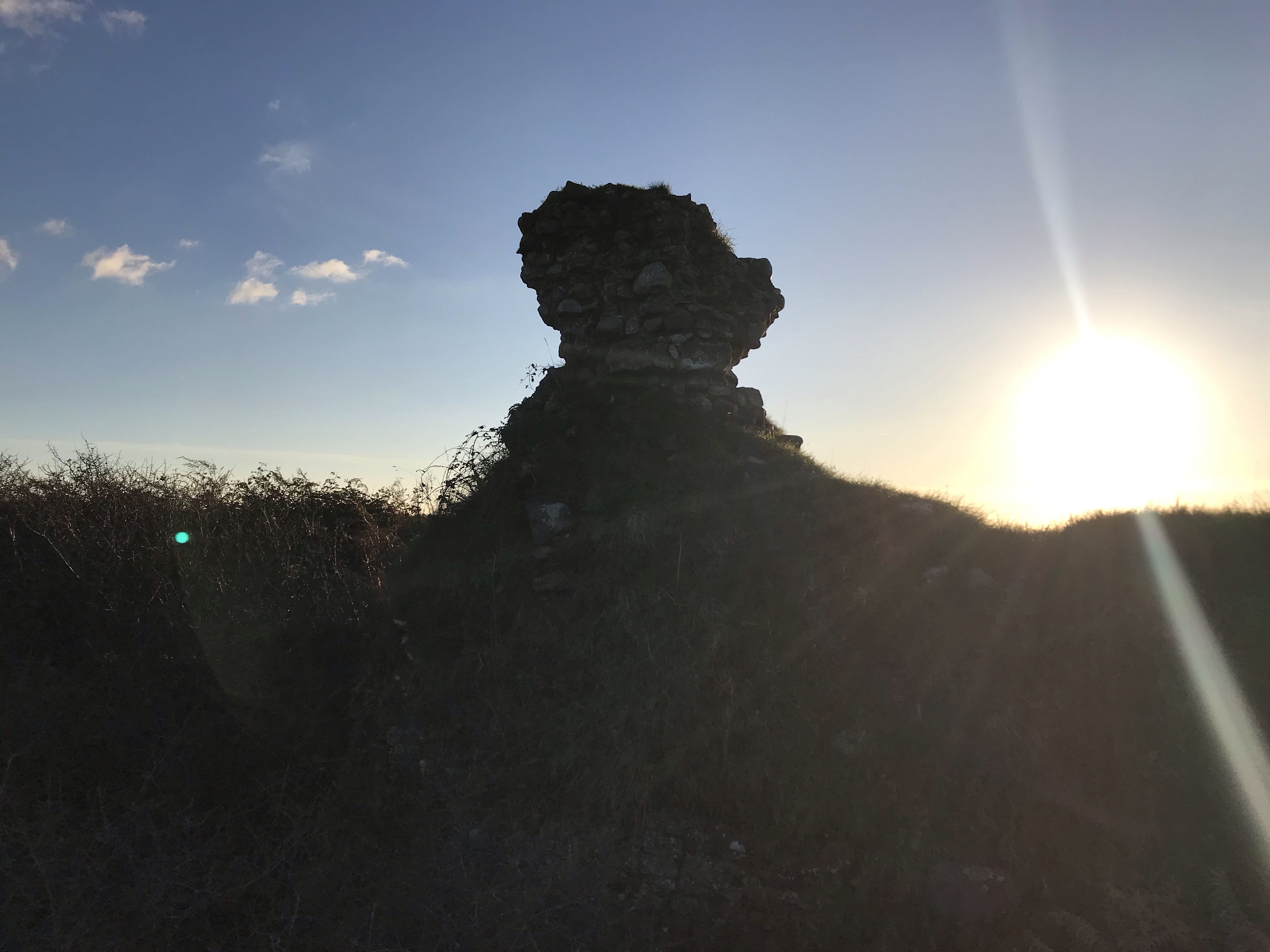
The Glamorgan History Walks was a walking festival of immersive history and storytelling that took ramblers around places of historic interest throughout South Wales. Bringing the stories of those places to life.
Between May and July in the Summer of 2024, over 350 people joined us on 15 walks to over 50 sites of historic interest in various locations across the counties of Bridgend, Vale of Glamorgan and Rhondda Cynon Taff.
We took in many castles, hill forts, barracks, burial chambers and tombs, great houses, churches, the site of lost settlements, smugglers’ coves and pirates’ hideaways. Even the odd battlefield, Prisoner of War camp, windmill and lighthouse. And of course, some great old pubs.
The festival was a great success. But it is not without its legacy.
All of the walks we did are now available to download for free, so you can be guided around them using the GPS on your mobile phone. You can also read notes on the routes and places you visit, and see which periods of history are relevant to those places. You can even watch videos to bring their stories to life.
Start your journey by visiting the Glamorgan History Walks web page. Choose a walk from the list and click through to the relevant page. To use the maps you will need to download the OS Maps App (which is also free).
The places we went to included:
Dunraven and Ogmore Castles
Llantwit Major
Monknash and St Donats
Barry and Porthkerry
Llantrisant
St Athan and Gileston
Llangynwyd
Coity
Merthyr Mawr and Island Farm POW camp
Kenfig Pool and Castle and Sker House
Mynydd Y Gaer and Peterston Super Montum
Cefn Cribwr, Bedford Iron Works and Sturmi Castle
Newton and Candleston
Dinas Powys
Cowbridge and St Hilary
Get out into the great and beautiful scenery of South Wales and enjoy everything these walks have to offer.
It has been raining so hard for so long here in Wales lately that I’m beginning to forget that it ever wasn’t raining. A depressing prospect for someone who loves nothing more than taking a walk around some local, historic monuments or sites of historic or legendary interest. Without having to wipe raindrops off my glasses to be able to appreciate them.
But of course we had a glorious Summer last year. So, the time has come to start looking forward and thinking about what we are going to do when weekends start to get warmer and dryer. When it stays light well into the evening.
To that effect I am planning a programme of history walks and talks this summer which I am inviting you to join me on. The plan is that they will all incorporate the following magical ingredients:
Walks of between 4 & 6 miles for various abilities
Start times around 9:00am
Beautiful Welsh countryside
Places of historical interest
The setting of some of Wales’ most wonderful legends and folklore
An author and broadcaster of Welsh history and other experts to tell the stories, sing the songs and bring them to life
Some weather (not necessarily sunshine, but definitely something!)
Some fun and laughs along the way
Always ending up at a pub for lunch and refreshments.
Jasper the history hound guarding my seat
This is roughly how the progamme is likely to look, but at this early stage it is subject to change:
History Walks and Talks in the Vale | May 2024
Saturday 4th May: Southerndown – Dunraven – St Brides – Ogmore Castle – Ogmore Estuary – The Three Golden Cups.
Saturday 11th May: Llantwit Major Square – The Castle Ditches – Collhugh Beach – Tresilian Bay – The Olde Swan Inn
Saturday 18th May: Monknash – Wick Beach – Nash Point – St Donats – The Plough & Harrow
Saturday 25th May: Dinas Powys Square – St George Woods – The Iron age Fort – Salmon leaps – The Star Inn
Bank Holiday Monday 27th May: St Athan – Berkerolles Tombs – East Orchard Castle – Boys Village – Gileston Manor – The Roost
History Walks and Talks in Bridgend | June 2024
Saturday 1st June: Ogmore Castle – Merthyr Mawr – Candleston Castle – Dipping Bridge – The Pelican in her Piety
Saturday 8th June: Coity Castle – Coity Common – Hendre – The Five Bells
Saturday 15th June: Llangynwyd Village – Llangynywd Castle & Woods – Gelli Lenor Fawr – The Old House Inn
Saturday 22nd June: Blackmill – Primaevel Woods – Mynydd Y Gaer – Peterston Super Montum – The Fox and Hounds
Saturday 29th June: Kenfig Pool – Sker House – Kenfig Castle – Mawdlam Church – The Prince of Wales
If there is enough demand, I may well add further walks in the other counties of Glamorgan. Namely Cardiff, RCT, Merthyr Tydfil and Caerphilly through July and August. As well as a pilgrimage walk I am planning from Llancarfan to the shrine of St Baruc on Barry Island on his feast day of Friday 27th September 2024. So watch this space.
In a nutshell, if you love history, and you love walks, pubs, South Wales and chirpy banter – then you’ll probably enjoy these walks.
If you would like to come along, tickets with be on sale soon for £10 per walker per walk, and will be available from this site and Eventbrite.
Over the coming weeks I will be doing risk assessments on each of the walks to make sure the routes are suitable but if you do fancy joining me, there are a couple of things you need to take into consideration.
We will be walking across country on public footpaths rather than just on roads and pavements. There will be mud, puddles, rocks and uneven surfaces. So stout footwear is required.
Many of these public footpaths require you to be able to climb over gates and styles. Dogs (on leads) and push chairs are welcome on these walks but you need to be prepared to lift them over such obstacles.
Like any outdoor activity you will need to be prepared for the predicted weather conditions of the day. Waterproofs for rain, sun hats and sunscreen for sunny days and so on.
Water bottles are essential to keep hydrated on these walks. You may also want energy boosting snacks.
When I publish the individual walk details they will feature important information to help you decide if the walk matches your abilities. These include distances in miles, the type of terrain we will cross, if the going is easy or tough, and if any climbing is involved. I will also flag any potential hazards such as stepping stones or cliffs. Please read these details carefully before committing to a walk. 🚶
If you would like to be notified when the itinerary is completed and tickets are available, or even if you just want to ask a question, please use the form below:-
I am currently making a series of documentaries about lost settlements. Places that pop up in historical documents and old maps but which don’t exist anymore. In my latest video I try and track down Bomium (or Bomio). It is mentioned in the Antonine Itinerary as being a fort and settlement somewhere on the Via Julia Maritima between Cardiff and Neath. But the milage calculations given are plainly wrong as they say 15 miles from Neath and 27 miles from Caerleon. As if those two places are only 42 miles apart along the old Roman Road. In reality its more like 55. So where was bomium?
If the distance from Neath was correct it would be the village of Stormy Down near Pyle. But there would be a lot more archeology in the area if that was right. Historians have suggested the XV should have said XX so, alternatives such as the Heronstone/Ewenny Priory area south of Bridgend and Ogmore Castle have been put forward.
When John Speed drew his map of Glamorgan in 1610, he marked Bomium on it. In his opinion, it was Boverton near Llantwit Major. And if the distance from Caerleon is correct, then Cowbridge is the most likely candidate. All of these suggested sites have some merit but none are perfect matches for a variety of reasons.
In this, my latest video, I have pulled together all the evidence we have that there ever was a Bomium, along with where it fits into the story of the Roman invasion and occupation of South Wales. After subduing the Silures.
We look at what history and archeology we have that narrow down the search. I also reconstruct the fort and show viewers where I believe the fort is hidden. And that might raise a few eyebrows. I also bring to life what Bomium would have been like in its hey day, and why it seems to have disappeared. We also challenge some of the accepted wisdom of what happened after the Romans left in general. After all, what have the Romans ever done for us?
I wrote a summary of the story in my first book Legends and Folklore of Bridgend and the Vale but have since found out a lot more detail and information.
It is available to watch in full on my YouTube channel. Just click on the link below to watch in full.
Kenfig; on the Glamorgan coast line is a bank of sand dunes and an inky black lake. But history tells us this was the site of a major town and port. The seat of a Royal household. And a place fiercely contested by Welsh warriors, raiding Vikings and Norman invaders. It was possibly the most significant settlement for miles around. But now, just a handful of cottages.
What happened here? How did this important place just disappear? Is the old legend that it still lies at the bottom of the lake true? What was it like in its prime?
All these questioned are answered from the places where they happened.
This video is an episode in the Ghost towns of Britain series.
Click to watch the video in full
In this series of short videos, I uncover the hidden truth of towns, villages and cities that have been lost to the sands of time. Nothing but a few remains and historical documents to give you any clue that they ever existed. I hope you enjoy them. And if you do, please subscribe to this channel and share them on social media.
And if you want to read more about the legends of Kenfig and surrounding area, this is the book for you.
In a churchyard in Monmouth stands one of the most curious tombstones in the county. And one so unique that it was given Grade II listed status in 2005. As you might expect with such a memorial, it and the man it commemorates, have quite a backstory. It concerns one man’s obsession with outsmarting the devil.
His name was John Renie and he was born in Monmouth in 1799 and worked as a painter and decorator in the town until he died in 1832. He was known to be one of the town’s more eccentric characters and nothing exemplified this more than a plan he hatched to try and ease his own passage to heaven on the event of his inevitable death. The plan was simple. He wanted his gravestone to be so confusing to read, that if the devil were to ever come looking for his soul, he would not be able to work out where his body was buried. Thus allowing Renie’s soul to slip past the devil, straight to the gates of heaven.
He became concerned that he would not be able to trust any local stone mason with this job. Either because he considered them incapable of pulling off his complex instructions, or worse, that they may reveal the secret of it to Satan himself. So to make sure the job was done properly he did the engraving himself. He dedicated years to getting it right. The end result is this fascinating and intricate, stone engraved ‘acrostic puzzle’.
It contains 285 very delicately carved letters in rows and columns. To be able to read the inscription you need to begin at a letter ‘H’ in the centre of the puzzle and follow the letters in any direction. Mathematicians who have studied the stone report that there are 32,032 different ways to read the words “Here lies John Renie”. It is quite an incredible achievement.
If the devil were not yet confused enough by John Renie’s endeavours, there is one final obstacle he might encounter if he was sufficiently determined to find his soul. And It is one Renie himself could not have foreseen but would no doubt have been absolutely delighted with. Put simply, the chances are, he probably isn’t even buried here at all!
In 1851, there was a rash of unexplained deaths amongst the residents of Whitecross Street in Monmouth. The street which runs along the edge of the churchyard at St Mary’s Priory Church, where this tombstone can be found. There were also reports of a terrible stench emanating from the raised area of the churchyard. The bodies and bones of the people buried there had become exposed by ground movement and weathering. All the exposed bodies had to be reinterred else where in the graveyard, but it was an impossible job to know who was who so they just did the best they could.
If this story is not already weird enough, the church council at the time decided to wade in with their own contribution. They felt that the churchyard looked over cluttered with memorials and headstones so a decision was taken to clear them all away as part of this work, to create a park. Only a small handful of stones now remain which have been laid out in accordance with the paths rather than where people are actually buried.
The end result. John Renie’s body could be anywhere. As could his soul.
If you want to see more of this tombstone and the yard of St Mary’s Priory Church in Monmouth, as well as other stories concerning the Devil in Monmouthshire I have made this YouTube video on the subject. Just click on the link below to watch in full. And while you are there, please subscribe to my channel.
If you would like to read more Monmouthshire related folklore, you might enjoy the blog and video available on this link. It is all about the scars of the reformation to be seen to this day at The Robin Hood in Monmouth and the White Harte in Llangybi between Usk and Caerleon. And if you like ancient Welsh myths, folklore and legends in general, then you may also be interested in the books I have written on the subject available to buy on this link. or my YouTube channel which is packed with loads of videos on the subject. Just visit https://youtube.com/GrahamLoveluck.
A new book called Monica was launched on Saturday 7th October at Cowbridge Town Hall in South Wales. It tells the story of a family who fled grinding poverty and endless wars in 1920s Poland to start a new life in France. France had suffered heavy losses in World War I and needed immigrant labour to work in the mines. This family were part of that solution but shortly after moving found themselves living under German occupation in World War II.
The story is told from the perspective of the youngest member of the family. A little girl known as Monia at home, but Monique to her French school friends. She finally becomes known as Monica when the family settled in the South Wales coal field after the war. She recounts day to day life under occupation and beyond. She also embodies some recurring themes throughout the story. The mass movement of people across war torn Europe and the breakneck pace of change in the 20th century. One of her uncles glibly comments over dinner that he was born before the Wright brothers had achieved flight but had lived to see a man land on the moon. A remark which so aptly sums that up.
At the launch, the author Graham Loveluck-Edwards talked about the very real people the book is based on. A little-known history which is part of our story of diversity in Wales.
At the end of the second World War, it was Britain which had lost so many men that additional workers were needed to fill jobs in the mines. Soldiers of the Polish Free Army had fought alongside the British. After the war they were given a choice: Return to their country of residence or stay in the UK to work in the mines here. And that was the story of this family. So, the book also deals with first impressions of South Wales in 1948, and the uniquely Welsh things which made it feel like home.
Graham also revealed at the launch that he is a lot closer to the story than people might realise. “The principal character; Monica is based on my own mother. And this is all based on the history of her family”. He went on “people who knew her from the days when she ran Sacha Boutique in Bridgend in the 1970s and the Elle Dress Agency in Cowbridge in the 1990s may remember her as a rather glamorous and flamboyant lady. They might be surprised at her humble origins in a family of Polish peasants whose existence was so precarious, they measured a good winter by the fact that everyone in the household had survived”.
Even without any personal connections, readers will find the book absorbing and the story it tells fascinating and at times, amusing. Graham who is better known for writing about ancient Welsh legends and stories about pirates and highwaymen said “you will find the stories in this book every bit as entertaining as anything I’ve ever written about pirates or mythical beasts. The difference is, there are plenty of people dotted around the UK who share this history and will see their own family history reflected in what I have written”.
‘Monica’ is now available to buy from this website as well as on Amazon and all good book shops.
You often hear people (of a certain age) reminiscing about lost institutions they used to know and love. Maybe it’s the chapel their nana used to go to that’s flats now. Or the local cinema that they used to queue up outside every Saturday that today is just a car park. However, it’s not very often that you find people waxing nostalgically about a scrap yard. But if you ask people who grew up in Barry in the 60s or 70s, very few will have nothing to say about Dai Woodham’s scrap yard. It used to occupy the old railway sidings next to the abandoned docks. It was a place that dominated the townscape. Even if you had no interest in it or what could be found there. It was difficult to ignore.
What made the place magical to so many and made it famous throughout the world was the mile after mile of decommissioned steam locomotives in various states of decay parked up there. As far as the eye could see. And even more magical if you were a curious little boy like I was the first time I visited Barry, you were allowed to climb up and play on them. What would the Health & Safety bods make of that today?
A good friend of mine suggested that I should make a programme about the yard and volunteered his expert knowledge. Great idea I thought, so I casually posted about the notion on social media, to see if I could flush out some personal recollections. I wasn’t really expecting much in the way of engagement.
How wrong could I have been. It seems that everyone has a story about Dai Woodham’s locomotive scrap yard.
I heard how children used to climb up the front of the first locomotive in a line, down the chimney into the boiler then through the cab and out the back, onto the front of the next one and so on, to see if they could clear the whole line without touching the ground. I heard how amateur film makers used to light fires next to the cabs and fan the flames so billows of smoke would swirl past them, so it looked on the film like they were driving a steam engine. Even if the one they were in didn’t even have any wheels.
Lots of people had stories about how pragmatic Dai was when it came to pricing. One person told me that he found a small green engine on the yard. He fell in love with it. But it was boxed in on all sides by far bigger locomotives, some of which were missing wheels. He asked Dai ‘how much?’ Dai looked at the engine, looked at the others around it and with an air of ambivalence said ‘£60 – if you can get it out”.
I also heard from the relatives of the great man himself and a lady who worked at the yard for most of her life. They told me about all the preservation societies who would come to the yard in their droves. Their mission? To buy locomotives to restore. Even the BBC TV’s kids programme Blue Peter came to buy one. And of course, the back story of the most famous locomotive of all – the Hogwarts Express. How the old GWR Haul Class 460 engine made its way from Barry Sidings to the silver screen.
When you think about it, nostalgia has always been the currency of Dai Woodham’s. People harking back to the golden age of steam are what kept the business viable for over 30 years. And now the yard is gone the institution itself is the stuff of relived memories.
Incidentally, I did make the programme. It will be broadcasted on Bro Radio FM on Monday 25th September 2023 after the 7pm news. But if the date and transmitter range are a barrier to you enjoying it, it is also available to watch on my YouTube channel at https://youtu.be/NScezzobFAI. #like and subscribe.
Moving a 100 ton locomotive is a delicate operation – which did not always go smoothly.
If you want to know more about Dai Woodham’s scrap yard there is a fantastic article from the Western Mail archives you might be interested in. Just follow this link.
Between 1830 and 1844 unrest amongst the industrial workers and farmers in Wales tipped over into riot and uprising. Nineteenth Century South Wales was a tinderbox of revolt. Industrialists were making fortunes in coal and steel but their workers were treated terribly. Living conditions were inhospitable and a breeding ground for cholera and other killer diseases.
High rents and low pay (not in cash but issued in tokens which could only be spent in the shops owned by their employers) made these people little more than slaves. And the introduction of credit and debt bound the working people still further to their employers and land owners.
Outside the industrialised areas things were no better. Welsh farmers and people living in rural areas were being bled by taxes and tythes and on the back of several poor harvests they found themselves on the brink of starvation. Something had to give. And the birth of new political ideas fuelled a number of uprisings.
The Merthyr Rising in 1831, the Rebecca Riots and the Newport Chartist Rising both starting in 1839. But what caused the rebellions? How did they start? Who was behind them? How did the establishment react? What has been their legacy?
In conversation, Graham Loveluck-Edwards and Mark Lawson-Jones pull back the layers of these events and their consequences. And as ever, especially for viewers in the Vale of Glamorgan, there is a tenuous local link. Watch below to find out what it is.
This is a really tragic, old legend from St Athan in the Vale of Glamorgan. The back story of an oft reported aparation of a white lady ghost in a field near West Orchard Castle. With a lot of historical context.
We hear about the second crusades, the De Clare family, the Berkerolles family, the Umphraville family, and of course the local castles at the heart of the drama.
The general gist of the story is Jasper Berkerolles of West Orchard Castle marries very well, but always harbours doubts that he is punching above his weight. And when he has to go to war he becomes consumed with jealously that she is having infidelities with his neighbour. When he returns home he is so tormented he condemns her to a gruesome death.
If you, like me, love a bit of Glamorgan history, folklore and legend, you may be interested in joining me at any number of talks I am giving in the coming months. As I am a guest speaker at most of these I have given details of the organisers so where tickets are required you know how to get them. Hopefully something for everyone here.
May Walks In The Vale Of Glamorgan 2023
with Chris Jones & Guests
7th , 13th, 20th and 27th May
After the incredible success of the 10 Days in May walking festival in 2022, Chris Jones is back with another walking festival through some of the Vale of Glamorgan’s most beautiful and historic locations. The theme is very much the same as last year with guided walks, talks about points of historical interest along the way (provided by yours truly) and some surprise appearances as character actors bring to life the stories associated with the area. It is tremendous fun.
These are the walks in this years event.
Sunday 7th May – The Iolo Morganwg Heritage Walk – Starting and finishing in Cowbridge. Meet for breakfast at The Maple and Bean (opposite Waitrose) at 10am.
Saturday 13th May – Llantwit Major and the Heritage Coast – Starting and finishing in Llantwit Major – Meet for breakfast 9.30am at the Piccolo Blu Cafe.
Saturday 20th May – St Athan and Gileston Walk – Start and finish at Gileston Manor where we will meet for breakfast at 9.30am.
Saturday 27th May – Dunraven Coastal Path Walk – Meet for breakfast at 9.30am at The Three Golden Cups in Southerndown.
If you would like to register for any of these walks then please click on the link go to the Visit The Vale website for information.
If that all looks a bit too energetic, then here are some other talks you might be interested in where the audience is altogether more static:
17th May – Social Sisters Barry (The Lounge, Tadcross) 8pm
10th June (2.00pm) – “The Cult, the Captain and the Baron” – the fascinating history of St Curig’s Church, Porthkerry
📍St Curigs Church, Porthkerry CF62 3BZ
🕰 2pm Saturday 10th June
💰 Free
13th June – WI Penarth
15th June – Cowbridge U3A
1st July – Ogmore Walk and Talk
I will provide information closer to the time for The Ogmore Walk and Talk and the St Curigs Porthkerry talks.
For the other talks above I am a guest of an organisation so you will need to contact them direct for more information. Contact details are available for all on Google.
If are interested in having me come along to one of your events to speak on any of my specialist areas, please click here for more information on what I can offer.
We use cookies on our website to give you the most relevant experience by remembering your preferences and repeat visits. By clicking “Accept All”, you consent to the use of ALL the cookies. However, you may visit "Cookie Settings" to provide a controlled consent.
This website uses cookies to improve your experience while you navigate through the website. Out of these, the cookies that are categorized as necessary are stored on your browser as they are essential for the working of basic functionalities of the website. We also use third-party cookies that help us analyze and understand how you use this website. These cookies will be stored in your browser only with your consent. You also have the option to opt-out of these cookies. But opting out of some of these cookies may affect your browsing experience.
Necessary cookies are absolutely essential for the website to function properly. These cookies ensure basic functionalities and security features of the website, anonymously.
Cookie
Duration
Description
cookielawinfo-checkbox-analytics
11 months
This cookie is set by GDPR Cookie Consent plugin. The cookie is used to store the user consent for the cookies in the category "Analytics".
cookielawinfo-checkbox-functional
11 months
The cookie is set by GDPR cookie consent to record the user consent for the cookies in the category "Functional".
cookielawinfo-checkbox-necessary
11 months
This cookie is set by GDPR Cookie Consent plugin. The cookies is used to store the user consent for the cookies in the category "Necessary".
cookielawinfo-checkbox-others
11 months
This cookie is set by GDPR Cookie Consent plugin. The cookie is used to store the user consent for the cookies in the category "Other.
cookielawinfo-checkbox-performance
11 months
This cookie is set by GDPR Cookie Consent plugin. The cookie is used to store the user consent for the cookies in the category "Performance".
viewed_cookie_policy
11 months
The cookie is set by the GDPR Cookie Consent plugin and is used to store whether or not user has consented to the use of cookies. It does not store any personal data.
Functional cookies help to perform certain functionalities like sharing the content of the website on social media platforms, collect feedbacks, and other third-party features.
Performance cookies are used to understand and analyze the key performance indexes of the website which helps in delivering a better user experience for the visitors.
Analytical cookies are used to understand how visitors interact with the website. These cookies help provide information on metrics the number of visitors, bounce rate, traffic source, etc.
Advertisement cookies are used to provide visitors with relevant ads and marketing campaigns. These cookies track visitors across websites and collect information to provide customized ads.