Posted on Leave a comment

New film about the Great Flood of 1607.

It was 9am on 30th January 1607, and the people of south Wales and the south west of England were going about their business as usual. Completely unaware of the horror that was approaching at a rate of knots.

Contemporary accounts describe what the people of places like Cardiff, Newport, Burnham-on-Sea and Ilfracombe saw that fateful morning when they looked out across the Bristol Channel. “A wall of water that did shut out even the sun”.

What was worse, this watery leviathan was fast moving. “No man could outrun it, even if riding on a galloping horse”. Over 2,000 people lost their lives that day. Thousands more died from the aftermath as famine set in. All the livestock had been drowned, top soil had been washed away and salt water contaminated the soil so no crops could grow for years afterwards. Even fresh drinking water became scarce as sea water had contaminated all the wells.

Pretty dramatic stuff I’m sure you would agree, and a story that needs to be told. So I have been planning on making a film about this event for some time.

Why this event?

I lived for many years in the pretty little village of Redwick on the Gwent Levels in Monmouthshire. A place which was wiped out at the time and has a marker on the church walls which shows how high the standing flood water was after the initial wave had gone. So, I was already aware of the event the history books call “The Great Flood”. My knowledge however was quite scant so I knew I needed to do some serious research to do it justice. Once I started pulling the various strands of research together however, I realised that this task was way too big for me to undertake on my own. So I reached out to various experts. Many in fields you would not associate with a history piece.

Archivists, meteorologists, geologists, geographers and even volcanologists all played their part in the making of this film. I learned so much more from doing this project than I ever could have imagined.

My Objectives With This Film

There were a few things I was particularly keen to do with this film.

The first was to make sure that proper emphasis was put on the price paid by the people and communities of south Wales. When I saw that Channel 5 had made a documentary called “The Killer Wave” about the event I was really interested. But was so dissapointed when I watched it to discover that it focussed entirely on the town of Barnstaple with hardly a mention of the impact on the south Wales coast. So to redress the balance my film focusses predominantly on places in Glamorgan and Monmouthshire. Barnstaple gets mentioned once.

Nothing personal – just that you’ve had your film. Now its our turn.

I also wanted to fill in some gaps in the history books. In additions to the loss of lives, livestock and property, significant buildings were lost that have never been replaced. Entire communities had to be rebuilt as 24 parishes had been lost to the waters. Also a rash of ports mysteriously disappeared around this time. I wanted to verify what was lost because of the flood and what was lost to other events (because as you will learn from this film, there were others).

Finally, I wanted to recreate some of the key events. I know not everyone is a fan of AI, but it is so much cheaper and easier to work with than CGI. So I used it to do some re-enactments and reconstructions to give a visual account of what happened.

Anyway, enough of me rambling on. The film is now done. It is 30 minutes long and it is available to watch on my YouTube channel. Please like and subscribe as the cool kids say.

To watch it from this page, simply click the image below to watch in full.

And who knows. May be we’ll feature some of these destinations in the forth coming Glamorgan History Walks programme?

#greatflood #tsunami

Posted on Leave a comment

A tombstone to confound the devil.

In a churchyard in Monmouth stands one of the most curious tombstones in the county. And one so unique that it was given Grade II listed status in 2005. As you might expect with such a memorial, it and the man it commemorates, have quite a backstory. It concerns one man’s obsession with outsmarting the devil.

His name was John Renie and he was born in Monmouth in 1799 and worked as a painter and decorator in the town until he died in 1832. He was known to be one of the town’s more eccentric characters and nothing exemplified this more than a plan he hatched to try and ease his own passage to heaven on the event of his inevitable death. The plan was simple. He wanted his gravestone to be so confusing to read, that if the devil were to ever come looking for his soul, he would not be able to work out where his body was buried. Thus allowing Renie’s soul to slip past the devil, straight to the gates of heaven.

He became concerned that he would not be able to trust any local stone mason with this job. Either because he considered them incapable of pulling off his complex instructions, or worse, that they may reveal the secret of it to Satan himself. So to make sure the job was done properly he did the engraving himself. He dedicated years to getting it right. The end result is this fascinating and intricate, stone engraved ‘acrostic puzzle’.

It contains 285 very delicately carved letters in rows and columns. To be able to read the inscription you need to begin at a letter ‘H’ in the centre of the puzzle and follow the letters in any direction. Mathematicians who have studied the stone report that there are 32,032 different ways to read the words “Here lies John Renie”. It is quite an incredible achievement.

If the devil were not yet confused enough by John Renie’s endeavours, there is one final obstacle he might encounter if he was sufficiently determined to find his soul. And It is one Renie himself could not have foreseen but would no doubt have been absolutely delighted with. Put simply, the chances are, he probably isn’t even buried here at all!

In 1851, there was a rash of unexplained deaths amongst the residents of Whitecross Street in Monmouth. The street which runs along the edge of the churchyard at St Mary’s Priory Church, where this tombstone can be found. There were also reports of a terrible stench emanating from the raised area of the churchyard. The bodies and bones of the people buried there had become exposed by ground movement and weathering. All the exposed bodies had to be reinterred else where in the graveyard, but it was an impossible job to know who was who so they just did the best they could.

If this story is not already weird enough, the church council at the time decided to wade in with their own contribution. They felt that the churchyard looked over cluttered with memorials and headstones so a decision was taken to clear them all away as part of this work, to create a park. Only a small handful of stones now remain which have been laid out in accordance with the paths rather than where people are actually buried.

The end result. John Renie’s body could be anywhere. As could his soul.

If you want to see more of this tombstone and the yard of St Mary’s Priory Church in Monmouth, as well as other stories concerning the Devil in Monmouthshire I have made this YouTube video on the subject. Just click on the link below to watch in full. And while you are there, please subscribe to my channel.

If you would like to read more Monmouthshire related folklore, you might enjoy the blog and video available on this link. It is all about the scars of the reformation to be seen to this day at The Robin Hood in Monmouth and the White Harte in Llangybi between Usk and Caerleon. And if you like ancient Welsh myths, folklore and legends in general, then you may also be interested in the books I have written on the subject available to buy on this link. or my YouTube channel which is packed with loads of videos on the subject. Just visit https://youtube.com/GrahamLoveluck.

The tombstone of John Rennie in Monmouth
Posted on Leave a comment

A great Welsh legend for Good Friday

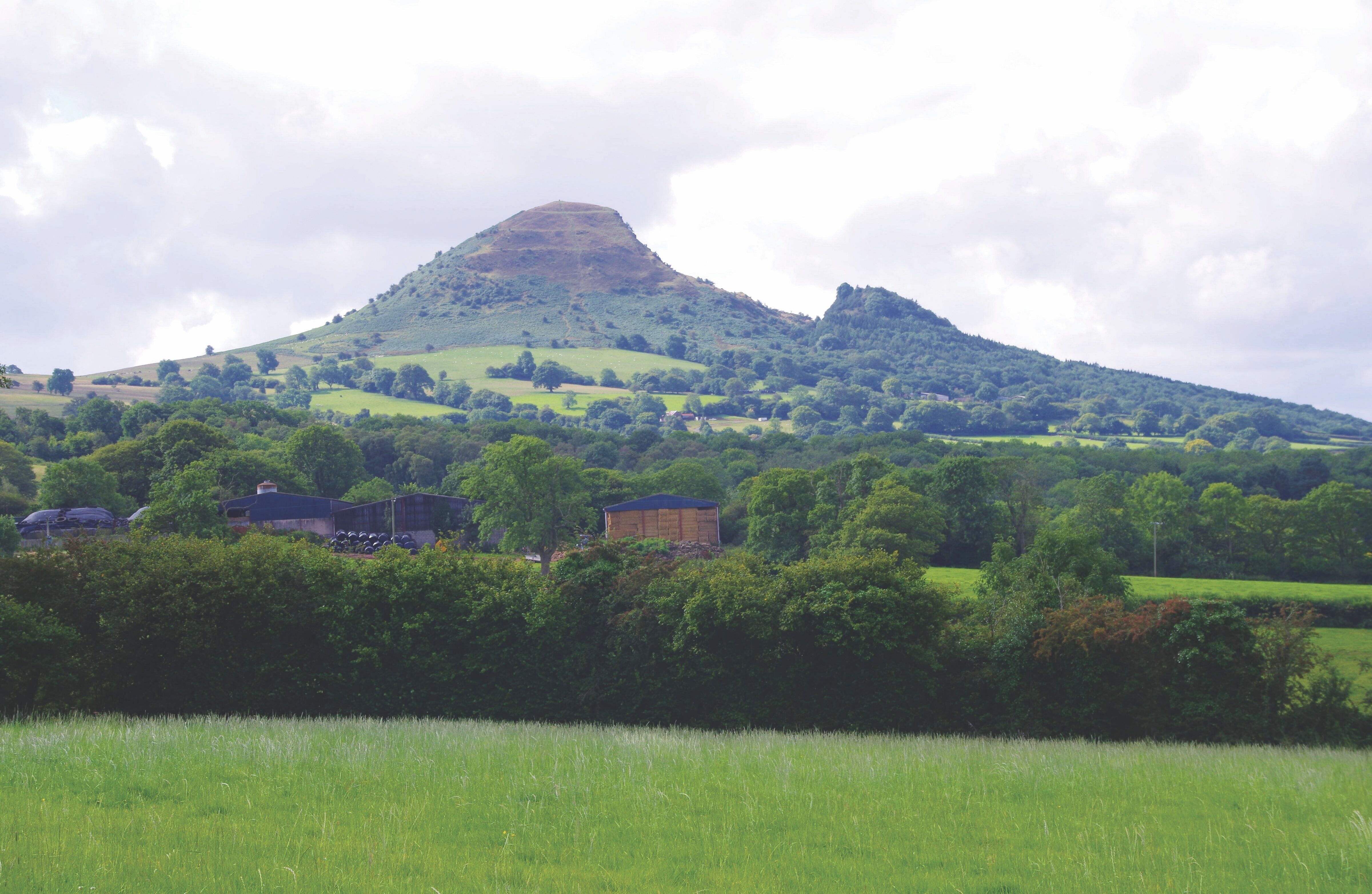
This is Mynydd Ysgyryd Fawr (or in English; The Skirrid). It lies north of Abergavenny in Monmouthshire. It is also known as ‘The Holy Mountain’.

Technically it is a hill not a mountain but the Welsh word ‘mynydd’ doesn’t have such a strict definition criteria as its English equivalent. It just means big hill.

It has a famous legend attached to it. It was said that at the exact moment of the crucifixion the whole mountain shook until the central section collapsed giving it the distinctive outline we see today.

The name ‘ysgyryd’ is derived from the Welsh word for earth quake.

In the medieval period it was a popular place of pilgrimage and at certain points of the path you can take if you are climbing it, there are old stone steps to help the pilgrims with their ascent. It is well worth the trip as the view from the top is amazing. You can see across 4 counties.

There is also a large flat stone, possibly a Neolithic monument, known as the Devil’s Stone half way up it. This time referencing another legend that the collapsed part of the mountain was used as a seat by Satan himself.

So something for everyone!