Posted on Leave a comment

New film about the Great Flood of 1607.

It was 9am on 30th January 1607, and the people of south Wales and the south west of England were going about their business as usual. Completely unaware of the horror that was approaching at a rate of knots.

Contemporary accounts describe what the people of places like Cardiff, Newport, Burnham-on-Sea and Ilfracombe saw that fateful morning when they looked out across the Bristol Channel. “A wall of water that did shut out even the sun”.

What was worse, this watery leviathan was fast moving. “No man could outrun it, even if riding on a galloping horse”. Over 2,000 people lost their lives that day. Thousands more died from the aftermath as famine set in. All the livestock had been drowned, top soil had been washed away and salt water contaminated the soil so no crops could grow for years afterwards. Even fresh drinking water became scarce as sea water had contaminated all the wells.

Pretty dramatic stuff I’m sure you would agree, and a story that needs to be told. So I have been planning on making a film about this event for some time.

Why this event?

I lived for many years in the pretty little village of Redwick on the Gwent Levels in Monmouthshire. A place which was wiped out at the time and has a marker on the church walls which shows how high the standing flood water was after the initial wave had gone. So, I was already aware of the event the history books call “The Great Flood”. My knowledge however was quite scant so I knew I needed to do some serious research to do it justice. Once I started pulling the various strands of research together however, I realised that this task was way too big for me to undertake on my own. So I reached out to various experts. Many in fields you would not associate with a history piece.

Archivists, meteorologists, geologists, geographers and even volcanologists all played their part in the making of this film. I learned so much more from doing this project than I ever could have imagined.

My Objectives With This Film

There were a few things I was particularly keen to do with this film.

The first was to make sure that proper emphasis was put on the price paid by the people and communities of south Wales. When I saw that Channel 5 had made a documentary called “The Killer Wave” about the event I was really interested. But was so dissapointed when I watched it to discover that it focussed entirely on the town of Barnstaple with hardly a mention of the impact on the south Wales coast. So to redress the balance my film focusses predominantly on places in Glamorgan and Monmouthshire. Barnstaple gets mentioned once.

Nothing personal – just that you’ve had your film. Now its our turn.

I also wanted to fill in some gaps in the history books. In additions to the loss of lives, livestock and property, significant buildings were lost that have never been replaced. Entire communities had to be rebuilt as 24 parishes had been lost to the waters. Also a rash of ports mysteriously disappeared around this time. I wanted to verify what was lost because of the flood and what was lost to other events (because as you will learn from this film, there were others).

Finally, I wanted to recreate some of the key events. I know not everyone is a fan of AI, but it is so much cheaper and easier to work with than CGI. So I used it to do some re-enactments and reconstructions to give a visual account of what happened.

Anyway, enough of me rambling on. The film is now done. It is 30 minutes long and it is available to watch on my YouTube channel. Please like and subscribe as the cool kids say.

To watch it from this page, simply click the image below to watch in full.

And who knows. May be we’ll feature some of these destinations in the forth coming Glamorgan History Walks programme?

#greatflood #tsunami

Posted on 2 Comments

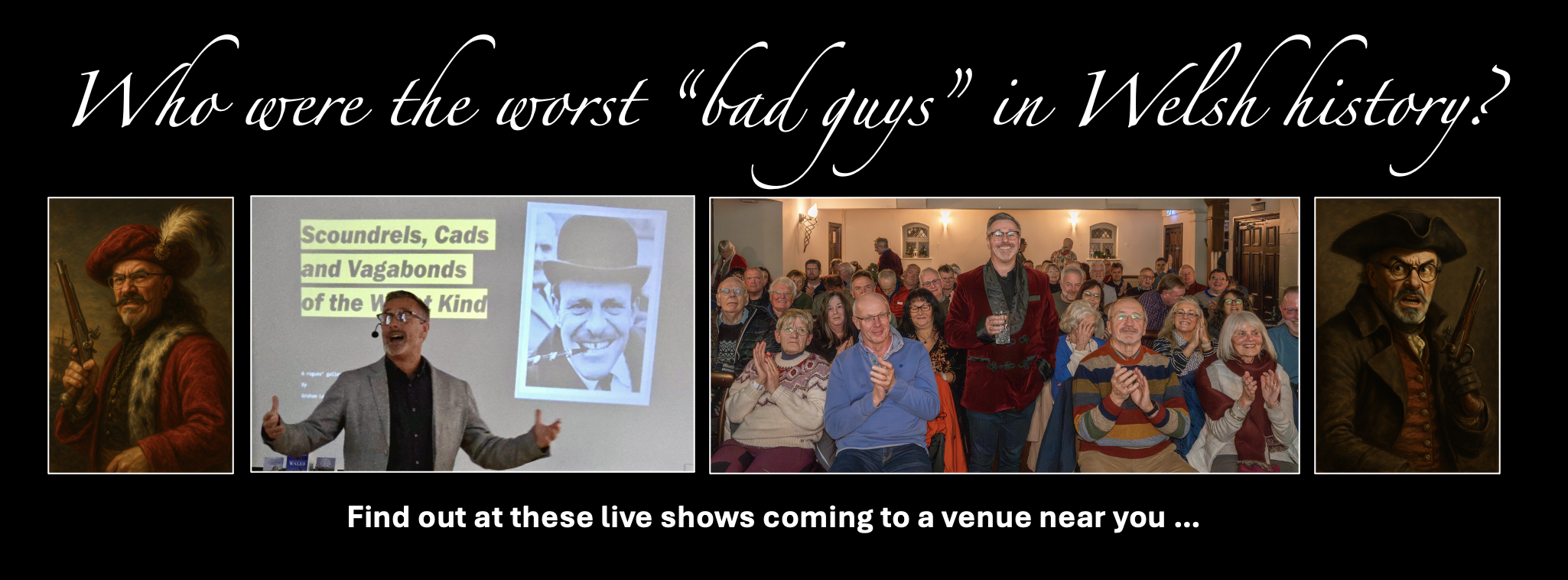
The “Worst Bad Guys in Welsh History” come to West and Mid Wales and the Welsh Borders.

Testimonials from people who saw the show in January 2026

Audiences have been raving about “The Worst Bad Guys in Welsh History” events being held in venues across Wales through 2026. An entertaining evening that combines history discussion, storytelling and ancient folk music, to demonstrate the various routes through which we get our history. Join us as we take a lighthearted look at some of the worst behaviour ever recorded, from the villains, scoundrels and bad guys of Welsh history.

After performing to sell out crowds across south Wales throughout January 2026, historian, author and broadcaster Graham Loveluck-Edwards (off the telly!) is bringing these events, based on his new book “Scoundrels Cads and Vagabonds from Welsh History” to venues in West Wales, Mid Wales and the Borders. Suitable for all ages. Tickets for adults ยฃ12, and children under 12 go free.

West Wales

19th March 2026 (7pm)St Peter’s Hall, Carmarthen>BUY TICKETS
20th March 2026 (7pm)Penparcau Hub Aberystwyth>BUY TICKETS
17th April 2026 (7pm)The Guildhall, Cardigan>BUY TICKETS
18th April 2026 (7pm)Haverhub, Haverfordwest>BUY TICKETS
25th April 2026 (2pm)Parc Howard Museum, Llanelli>BUY TICKETS
Dates and venues for Carmarthenshire, Pembrokeshire and Ceredigion

Powys

21st March 2026 (7pm)Pant-Y-Dwr Hall, Rhayader>BUY TICKETS
26th March 2026 (7pm)Knighton Centre, Knighton>BUY TICKETS
Dates and venues across Powys

Gwent

12th February 2026 (7pm)St Woolos Cathedral, Newport>VIEW DETAILS
27th March 2026 (7pm)Melville Theatre, Abergavenny>BUYTICKETS
23rd April 2026 (7pm)Miners’ Institute, Cefn Fforest>BUY TICKETS
Dates and venues for Gwent (Newport, Torfaen and Monmouthshire)

How to order tickets:

Here’s how to get your ticket. First of all, from the list above, choose the date and venue that suits you best and click on the “>BUY TICKETS” link to see full information about the venue including: time of performance, a Google Maps pin, best place to park and bus routes. Once the page opens, if you are using a PC the ticket buying widget is to the right of the main photo. If you are using a phone, scroll right the very bottom of the page. Select how many tickets you want with the + and – buttons. Once your transaction has gone through you will be sent an order confirmation email.

THERE IS NO NEED TO DOWNLOAD OR PRINT OFF TICKETS. Once you have ordered tickets, your name gets added to a guest list which we go through on the door.

Video Taster

Want a flavour of these events? Sure! Here is a short video that was shot at the Pontypridd event earlier in the year. It gives you an idea of content and delivery without any spoilers. Enjoy.

An exert from one of these events held in Pontypridd in January 2026

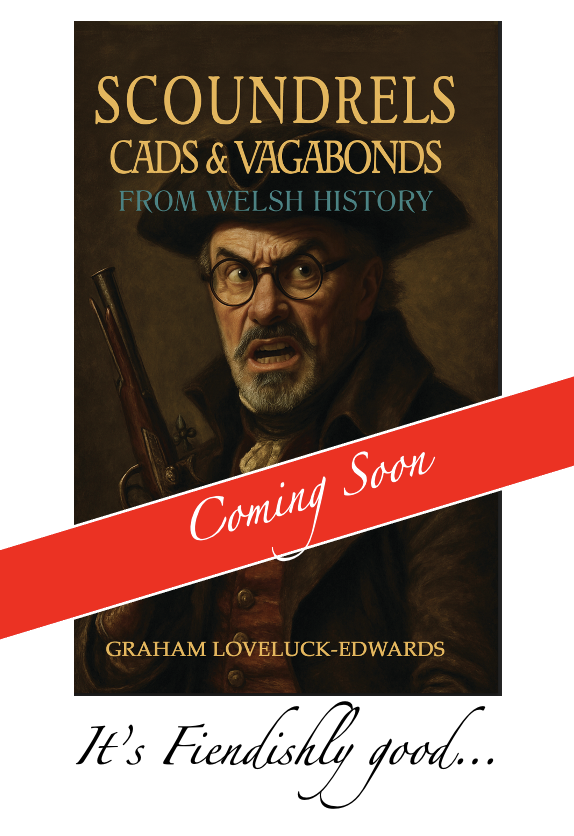
Scoundrels cads and vagabonds from Welsh history cover artwork

Get the book…

These events are based on Graham Loveluck-Edwards’ latest book: Scoundrels cads and vagabonds from Welsh history.

A compilation of bad guys and horrible history from Wales. This is Graham Loveluck-Edwardsโ€™ fifth book on Welsh history and those who love his witty style and irreverent approach are in for a real treat in this rogues gallery of scoundrels and their scandalous behaviour. Everything from traitors to tyrants and from pirates and highwaymen to the bishops who bent the rules.

It is available to buy for ยฃ13.99.

scoundrels from Welsh history tour banner
Coming to a venue near you
Posted on Leave a comment

Traditions of a Welsh Christmas

The Mari Lwyd

Wales has a raft of very distinct and unique traditions associated with Christmas and the new year.

I have made the little video below to illustrate what makes a traditional Welsh Christmas different from any other. And to make life easier, below I have added explanations of what you are looking at in each sequence:

Opening scenes: When I was growing up, the site of wild horses and loose sheep wandering through the streets of rural villages was a common one. I could not make a video about traditional Wales without including a couple.

  • Week before Christmas: Busy traffic in Cardiff City Centre passes under bright and gaudy decorations, the stalls in Cardiff Market are bustling with last minute shoppers. And now is the time for the obligatory visit to Santaโ€™s grotto in Howells. Whether you like it or not.
  • The Plygain is a uniquely atmospheric carol service held just before their sun rises on Christmas Day. Usually between 4 and 6am. The local chapel would be flooded with candlelight and villagers would gather to sing carols in close harmony, unaccompanied. I am delighted to hear that there are still some places where this happens regularly.
  • Hunting the wren: OK. I grant you, this one is a bit weird. On Boxing Day (the feast of St Steven) a wren is killed and put in a box which is decked out with ribbons and leaves. Then a brigade of men parade from house to house โ€œwassailingโ€. For the uninitiated, wassailing is part carol singing and part merrymaking and dancing. In some communities people used to dress up, play instruments, sing and dance as they went from house to house, either for money, or more usually, free beer from the householder. There are similar traditions on the Isle of Mann and Ireland.
  • Holming: If you thought killing a wren wasnโ€™t particularly PC, brace yourself. In the earliest accounts of this tradition it was customary for the last maiden in the house to rouse from their beds on St Stevens Day to be beaten with holly until they bleed. It was believed to bring all parties good luck. In more recent history itโ€™s just been a license for children to shame their parents for over indulging on Christmas Day. As if a hangover were not enough.
  • Calennig: A nice new year custom. Children would carry decorated apples (or oranges if they were a bit flash) from door to door and sing in exchange for money or sweets.
  • Mari Lwyd: The Mari Lwyd has seen a huge resurgence in popularity in recent years. Itโ€™s one of those weird and wonderful things that plays well on social media. If you are not familiar, itโ€™s an ancient new year ritual. A horses skull bedecked with ribbons and sometimes jewels is carried on a pole by a man under a sheet from house to house. His company knock on each door to demand entry, but every householder refuses entry, so a battle of wits ensues. Known as โ€œpwncoโ€, it is an early form of rap battle. Protagonists on either side of the door set riddles and rhymes until the householder relents and lets them all in to gorge themselves on as much food and drink as the householder can offer. In case youโ€™re wondering, Mari Lwyd means grey mare.

Many people believe that this tradition has its origins in the ancient worship of a pagan horse god, others in the enactment of medieval mummer plays. Written references to it prior to the 19th Century are pretty thin on the ground and there are similar traditions associated with mid summer in Cornwall and Cumbria, so in truth, no one really knows where it originates.ย 

So there you are. Some unique and wonderful ways to celebrate Christmas and the new year from the people of Wales. Nadolig Llawen.

#Chritsmas #Wales #folkore

Calennig is a lovely new year tradition where children carry decorated apples and oranges and go singing from house to house

If you are interested I have designed a rather snazzy Mari Lwyd T shirt with the ballad of the Mari lwyd written on the back (available in english or Welsh and in a range of colours and sizes. Follow the link below:

Mari Lwyd T Shirt
Mari Lwyd T Shirt
Posted on 2 Comments

Bridgend through time

This Video of old Bridgend has been made by animating old photographs taken between 1880 and 1950 in the town centre.

Everyone I know whoโ€™s from Bridgend says the town is nothing like it used to be. So in case you were curious, here is a video showing what it used to be like. Have you ever wished you could step back in time,  just to have a look around? Now, thanks to modern AI, we can do exactly that. 

I realise that some of these landmarks have changed a lot down the years, so here is what you are looking at, in each clip:

  1. Yr Hen Bont (the Old Bridgend). The 15thC bridge which the town owes its existence to
  2. Four scenes showing Dunraven Place and the Wyndham Hotel (now a Wetherspoons)
  3. Cart on Ewenny Road
  4. Bus on Adare Street
  5. The Castle Hotel and Nolton Street 
  6. The old town hall
  7. The clock on London House
  8. Two views from opposing directions of Dunraven Place
  9. The Rhiw market
  10. Couple of police at Waterton Cross
  11. Few more of London House
  12. St Johnโ€™s house hospice
  13. The cenotaph 
  14. Bridgend railway station
  15. Waving crowds in Adare Street

#Bridgend #oldphotos #history

Posted on 1 Comment

Old photos of Victorian Cardiff animated into life

Cardiff Castle south gate 1890

When I visit a city full of history like Cardiff, I often wish I could step back in time, just to have a look around and see it as it was in its hey day. Thanks to modern AI, we can now do exactly that and as 20th December 2025 marks 70 years since Cardiff was made capital city of Wales it seemed a fitting time to make this video.ย 

I have created it by using AI to animate a series of photographs taken at various points around Cardiff between 1880 -1909. I have seen these photos many times before but the injection of movement and human interaction really adds another dimension to them.

I realise that some of these landmarks have changed a lot down the years, so here is what you are looking at, in each clip:

  1. Trolley buses in front of Cardiff Castle. Note the โ€œAnimal Wallโ€ used to be there and not along Bute Park as it is today.
  2. Walking towards Canton Bridge looking up at Duke Street. Castle and clock tower in the back left
  3. Castle walls and clock tower strewn with ivy
  4. Castle South Gate, facing onto Duke Street and part of animal wall.
  5. An ivy covered Norman keep inside the castle
  6. The newly opened Westgate Street which follows the old course of the River Taff, after the land had been reclaimed by Brunel
  7. High Street, looking towards the castle
  8. The first ever edition of the South Wales Echo from 6th November 1880
  9. The Empire Theatre on Queen Street
  10. The old town hall which used to stand where Quay Street meets High Street
  11. Another view of the High Street, town hall on the left
  12. The Angel Hotel as it used to be
  13. Crowds gather outside a pub in Bute Terrace (a murder had just been committed inside).
  14. Queen Street
  15. Duke Street
  16. Four views of Cardiff Docksย 
  17. The Glamorgan Canal
  18. Cardiff Docks
  19. The old โ€™Tiger Bayโ€™
  20. Hospital ship
  21. Football fans at a Cardiff game
  22. Cardiff Intermediate Schools Team 1909

To watch the video just click on the image below…

Now that I’ve got the bug I fully intend to make a few more of these. Taking a retrospective wander down the streets of Welsh towns, cities and villages and breathing some life back into age old photographs.

#Cardiff #oldphotos #history

Cardiff Docks 1890
Cardiff Docks 1890
Posted on 1 Comment

The Worst Bad Guys in Welsh History Tour January 2026

scoundrels from Welsh history tour banner

South Wales

Live shows based on the new book “Scoundrels, Cads and Vagabonds from Welsh history” by Graham Loveluck-Edwards

January 26 book tour venues

South Wales tour January 2026

Who were the worst bad guys in Welsh history? The most tyrannical rulers? The most blood thirsty outlaws? The most unscrupulous traitors?

As Graham Loveluck-Edwards (author of Historic Pubs of Wales) takes us on a light-hearted romp through this roguesโ€™ gallery of scandalous behaviour. Everything from medieval massacres to swashbuckling pirates. Even a few Kings of England thrown in for good measure. All viewed from the perspective of the people of Wales. We look at their antics and ask, โ€œdo they deserve their bad reputations?โ€

Just so you know, the answer is usually โ€œyes!โ€

โ€œGraham Loveluck-Edwards is an absolute legend. Heโ€™s got this unbelievably infectious passion for history, incredible knowledge, and beautiful hazel eyes. The Paul Hollywood of history.โ€

BAFTA award winning writer and actor Charlie Cooper

โ€œLoveluck-Edwardsโ€™ narrative style harkens back to fireside tales of old with the perfect balance of wickedness his devotees have come to love.

If your inappropriate pre-2000s history teacher had one or two sherries and wrote a book on Wales, this would be it.

I learned more than I expected to. I laughed more than I should haveโ€ฆโ€

Stephen Price โ€“ Nation Cymru

Date & TimeVenue
Thursday 8th January (7pm)Town Hall, Cowbridge
Friday 9th January (7.30pm)St Maryโ€™s Hall, Talbot St, Cardiff
Tuesday 13th January (7pm)The Museum, Pontypridd
Thursday 15th January (7pm)Pioneer Hall, Barry
Friday 16th January (7pm)Vivian Hall, Blackpill, Swansea
Saturday 17th January (7pm):Town Hall, Neath
Thursday 22nd January (7pm)St Augustines Hall, Penarth
Friday 23rd January (7pm)Town Hall, Llantwit Major
Saturday 24th January (7pm)Coychurch Memorial Hall, Bridgend
Thursday 29th January (7pm)The Prince of Wales, Kenfig, nr Porthcawl
Friday 30th January (7pm)Soar Centre, Penycraig, Tonypandy
Thursday 12th February (7pm)St Woolos Cathedral, Stow Hill, Newport
Scoundrels talk
Scoundrels talk

Get the book which accompanies these talks…

Scoundrels cads and vagabonds from Welsh history cover artwork

Scoundrels cads and vagabonds from Welsh history is available now. A tongue in cheek, rogues gallery. The worst people and their scandalous antics and how they impacted on the history of Wales.

Available to buy here.

Posted on Leave a comment

What would you like to see on next year’s walks?

Coity Castle on the Glamorgan History walks 2025

The Glamorgan History Walks Festival 2025 is now come to an end but what a glorious event it was. Between May and September this year 885 people joined us on 52 walks across 33 different routes. We visited places with incredible history, told the stories of the people and events that happened there and took in some of the most beautiful scenery and architecture Wales has to offer.

But far be it from us to rest on our laurels.

We are already thinking about next year and how we can make this event bigger, better and give our walkers more of what they want. So to help us do it, please please please take part in our little survey. Its only 10 questions and two of those are name and email and 6 of them are yes no answers so it will take you seconds.

By taking part you are also entering a competition. One lucky survey participant will win a stylish Iestyn Ap Gwrgant T shirt (either in English or Welsh). The winner will be drawn at random. T shirt competition element closes 9th October 2025.

Posted on Leave a comment

Breaking News! Book number 5 and a tour.

Scoundrels cads and vagabonds from Welsh history coming soon

Everyone knows that I am rubbish at keeping secrets, so I might as well get it off my chest now. Yes, I have a new book coming out in October. This will be my fifth book on Welsh history and folklore and this time it revels in the misdeeds of some of Wales most wicked miscreants.

It is called “Scoundrels, Cads and Vagabonds from Welsh History” and is published by Candy Jar books and distributed by Books Council For Wales/Cyngor Llyfrau Cymru.

What’s it about?

It is the definitive collection of Welsh horrible histories.

It is all based around questions such as: Who were the worst bad guys in Welsh history? The most tyrannical rulers? The most blood thirsty outlaws? The most unscrupulous traitors?

So to answer them, in this book I take a light-hearted romp through a roguesโ€™ gallery of scandalous behaviour.

Everything from medieval miscreants to swashbuckling pirates. Even a few Kings of England thrown in for good measure.

All viewed from the perspective of the people of Wales. We look at the antics of these scoundrels and ask, โ€œdo they deserve their bad reputations?โ€

Just so you know, the answer is usually โ€œyes!โ€

As you can guess, it is intended to be a bit of fun so as much as what is contained in it is factually correct, it is told in a manner intended to amuse and entertain. A great ‘gateway’ into history for younger readers, or an alternative narrative for people who are more absorbed by the topic.

Who is in the book?

Well I don’t want to give too much away but I do have certain rules around who is in and who is out.

First of all, to get a mention in this book you need to feature in Welsh history. That does not mean however that you have to be Welsh.

There is no question that Edward Longshanks was not Welsh. Equally however, there is no doubt that he made a big impression on Welsh history.

Secondly, there is no one in this book in living memory. My intention when writing it was to give you a light-hearted overview of some scandalous behaviour from history. The trouble with people in living memory is that commentary on their actions becomes political rather than historical and that isnโ€™t as much fun.

So as much as you might be able to think of any number of politicians from the last 100 years who would qualify as scoundrels, none of them have made it into this book. Even though some undoubtedly deserve to be.

Finally, of course, to make it into this book you will need to have done something very naughty indeed. Something utterly scandalous in fact. It is a roguesโ€™ gallery. A compendium of cads, scoundrels, blackguards and neโ€™r do wells.

How will I be able to get a copy?

It wont be available in the shops or on Amazon until 27th October but you will be able to get it earlier than that exclusively on my website from 13th October (or possibly earlier printers dependant). It will retail for ยฃ13.99.

Did you mention a tour?

Good memory. Yes I did. I have written a live show based on the book. It is predominantly a ‘history talk’ but with a few flourishes and surprises along the way to liven things up a bit. The long term plan is take it on tour to venues all over the country so more dates and venues will be announced.

In the mean time however, I have my dates and venues for January 2026 nailed down and they are part of the Glamorgan leg of the tour.

And here they are:

โ€ขThursday 8th January (7pm):   Town Hall,   Cowbridge

โ€ขFriday 9th January (7.30pm):   St Maryโ€™s Hall, Talbot St,   Cardiff

โ€ขTuesday 13th January (7pm):   The Museum,   Pontypridd

โ€ขThursday 15th January (7pm):   Pioneer Hall,   Barry

โ€ขFriday 16th January (7pm):   Vivian Hall, Blackpill,   Swansea

โ€ขSaturday 17th January (7pm):   Town Hall,   Neath

โ€ขThursday 22nd January (7pm):   St Augustines Hall,   Penarth

โ€ขFriday 23rd January (7pm):   Town Hall,   Llantwit Major

โ€ขSaturday 24th January (7pm):   Coychurch Memorial Hall,   Bridgend

โ€ขThursday 29th January (7pm):   The Prince of Wales,   South Cornelly

โ€ขFriday 30th January (7pm):   Soar Centre, Penycraig,   Tonypandy

In February and March I also intend to add dates in Merthyr Tydfil, Carmarthen, Llandudno, Bangor , Wrexham, Aberystwyth, Brecon, Abergavenny, Newtown, Newport and anywhere else they’ll have me.

Tickets will cost ยฃ12 and will go on sale in October, and once again, the best place to get them is from the website.

So for the person in your life who is “difficult to buy for” here is a selection of great Christmas presents to choose from. A book and a ticket to the show for a fraction under ยฃ26. Not bad!

Scoundrels January 2026 tour poster A4

Would you like me to contact you when its available to buy?

Just in put your details below. No charge, no obligation. Once the books arrive you will be contacted and offered first dibs on a first print run of the first edition.

โ† Back

Thank you for your response. โœจ

Posted on Leave a comment

The forgotten king of England.

It seems that every historian worth their salt is currently slagging off the BBC Drama โ€œKing and conquerorโ€. If you havenโ€™t seen it, it is loosely based on the events leading up to the Battle of Hastings in 1066.

Most of the noise is centred around โ€œthe wrong king having a moustacheโ€.

This is a joke enjoyed by people who like to show off that they know what is on the โ€˜Bayeau Tapestryโ€™.

All the characters on this famous embroidery look very similar but to help you tell them apart William is always depicted as clean shaven and Harold Godwinson with a blonde, handlebar moustache.

Yes! Itโ€™s not a very funny joke is it?

What about Edgar?

Edgar ร†theling the forgotten king

For me however, the glaring wrong I wanted to put right was to remind the world of one of the most fascinating and often forgotten characters from this whole affair who never even got a mention.

Edgar ร†theling.

He is one of the most fascinating โ€œwhat-ifโ€ figures in English historyโ€”he was technically proclaimed king in 1066 but never crowned, and his whole life was shaped by being the almost-king who never quite made it.

Family Background

He was born around 1051, although we are not certain of the details. Other than to say that it is most likely that he was born in Hungary.

I told you he was fascinating.

He was the Grandson of King Edmund Ironside who was king of England for 7 whole months in 1016. His father, Edward โ€œthe Exile,โ€ was sent abroad as a child after the Danish conquest that saw โ€˜Cnut the greatโ€™ crowned king. He grew up in Hungary, and only returned to England in 1057โ€”where he died almost immediately.

This made young Edgar the last direct male descendant of the House of Wessex, the old royal line of Alfred the Great and ร†thelstan.

Claim to the throne

When Edward the Confessor died in January 1066, Edgar was still a teenager. Despite being the rightful heir in strict hereditary terms, the English nobility preferred Harold Godwinson, who was militarily strong and already a power in England.

After Haroldโ€™s death at Hastings (14 October 1066), the Witan (council of nobles) briefly proclaimed Edgar kingโ€”but he was never crowned. Within weeks, Edgar and the surviving English leaders submitted to William the Conqueror, realising that resistance was futile.

Role after 1066

William took Edgar to Normandy in 1067, parading him as a sort of hostage before briefly being freed and restored to favour.

This favour was short lived though as he unwittingly became the focus of an uprising which William quashed. Edgar fled to Scotland, where his sister Margaret married King Malcolm III, strengthening his support base.

In 1069 Edgar joined a rebellion at York with Danish allies, but it failed, leading to Williamโ€™s infamous Harrying of the North. Despite these efforts, Edgar never mustered enough strength to reclaim the throne.

Later life & legacy

He spent much of his life moving between England, Scotland, Normandy, and Flanders, often as a pawn in other rulersโ€™ politics.

In 1097, he accompanied his nephew (Edgar, son of Malcolm and Margaret) back to Scotland to secure the Scottish throne. He even took part in the First Crusade (1099โ€“1100) in the retinue of Robert Curthose, Duke of Normandy and William Iโ€™s eldest son.

After 1106 he largely disappears from records.

He died around 1126 and was buried at Gloucester, still unreconciled with his missed kingship.

Edgar ร†theling is remembered as the uncrowned king of England: Last male-line heir of the House of Wessex. Proclaimed but never crowned in 1066. A reminder of how the Norman Conquest closed the door on Anglo-Saxon royal succession.

And he didnโ€™t even get a mention in โ€˜King and Conquerorโ€™. Having said all that, as a piece of entertainment I did enjoy the series.

Jumping on the band wagon- slagging off King & Conqueror.
Posted on 2 Comments

Visiting Wales in the 18th Century – Part 1

Coalt Hoare Glamorgan Montage

When weโ€™re on holiday Iโ€™m sure most of us like to check out online reviews and guide books. To get inspiration for places to visit.

You may be surprised how interesting it can be to do this in reverse.

I once found myself having to kill time in an airport book shop. There was the initial moment of disappointment when I discovered that they didnโ€™t stock any of my books, but after I had got over that I started thumbing through the books they did have.

One was a guide for people visiting Wales. Out of curiosity I picked it up. I was wondering what outsiders made of places I knew and loved, and what recommendations they would make.

That got me thinking.

What did people make of Wales when they visited it back in bygone eras? What did they see? How different was their experience to that of a modern traveller?

When the grand tour was nothing to do with Jeremy Clarkson.

There was a long standing tradition amongst the young men born of aristocratic families to go on what was known as “the Grand Tour”. It meant traveling through Europe to visit the major cities and capitals of the continent to better acquaint themselves with the architecture, the art and the culture.

Then every now and then, Britain would go to war with France or Spain or the Netherlands making overseas travel too dangerous, so they would have to find destinations closer to home to explore.

Some came to explore Wales, but in these days before Trip Advisor and Expedia, they had to rely on diarists who had gone before them. To plan their routes and itineraries, and to decide where to stay.

One of my favourite pioneers of this brave new world of stay-cations, was Sir Richard Colt Hoare 2nd Baronet.

Before there was Trip Adviser, there was Sir Richard Colt Hoare

His ancestors had established Hoar’s merchant bank in the City of London in 1672. Itโ€™s still going. Itโ€™s the oldest Merchant bank in London. His father was also Lord Mayor of London, so, the family was not short of a bob or two. There are many reasons why I love Sir Richard. First of all, he was obsessed with all things historic.

He sunk a large part of his personal fortune into sponsoring archeological digs and in the acquisition of ancient texts and manuscripts. According to the Bishop of Salisbury, his library at his home at Stourhead in Wiltshire (which is now owned by the National Trust) boasted one of the finest collections of ancient manuscripts in the world. It even included writings by the legendary 13th Century Welsh Bishop, traveller and chronicler Giraldus Cambrensis (Gerald of wales).

These historic writings in particular, also inspired his other great passion. Travel.

More significantly, a desire to travel through Wales and revisit the places Gerald had written about to see how they had changed.

No doubt, also partly inspired by Giraldus, he had a hunger for documenting everything. He kept a diary and would religiously write in it about the places he visited and the things he saw. He would also meticulously record his opinions of the places he visited and the quality of the food and service at inns he stayed at.

This for me is the best thing about his diary.

That and how his experiences highlight how much travelling through Wales has changed.

Reviews of places you know

Some of Sir Richard’s experience of traveling in South Wales were “most grievious”. Not least getting here in the first place. He was of course traveling into Wales at a time before the two bridges spanning the Severn Estuary had been built. He crossed at what used to be known as ‘New Passage’. This was a ferry route between the village of Redwick in South Gloucestershire and Portskewett in Monmouthshire. This was his description of his crossing:

Thursday 2nd May 1793

“After a rough and tedious passage of two hours and a half, I landed on the opposite side of the channel. I never would recommend anyone to go over in the large passage boat (as I did) but to take a small one, as the former is generally much loaded with cattle and horses, which are not the pleasantest companions on a rough sea”

So crossing the Severn Estuary used to take up to 2 1/2 hours, and you had to share the deck with anxious livestock. I can only imagine how rough that must have been and certainly puts into context my woes of traffic jams around Bristol.

When he got to Wales though, he soon cheered up and recorded: “I proceeded to Chepstow… the Beaufort Arms is the best inn. After dinner I continued through Raglan… there is a tolerable inn… but bad attendance.”

He didnโ€™t pull any punches with his reviews of inns he stayed or dined at.

The first time he visited Cowbridge he was clearly in a bad mood as this was how he described it

Monday 8th July 1793

“In the evening I proceeded on my journey through Cowbridge. Situated in a bottom and consisting of one long street. The inn is indifferent.” – Harsh!

For balance I should add that he came back in 1797. On his second visit he stayed at the Bear (which is still there) which he was very complimentary about.

More complimentary reviews

Another traveller of this era was a chap called The Rev William Gilpin who visited in 1770. He loved Monmouthshire in particular and described the Wye as his favourite river. He may have dismissed the countryside between Pyle and Bridgend as a “vile heath” but he went into gushing raptures about the town of Bridgend it self.

He wrote: โ€œA beautiful landscape burst again upon the travellers. Woody banks arose on both sides… which continued a considerable way, marking the course of the river.”

Wow! Thatโ€™s changed a bit then!

It is worth pointing out that the stage and post coaches of this era did not always go into Bridgend itself. If you were London bound, the most direct route was along New Inn Road in Merthyr Mawr which might explain the landscape he described.

Gilpin also loved Llanblethian and was so moved by the site of St Quentins castle, he stopped to sketch it.

Another contemporary on a similar trip was Henry Penruddocke Wyndham from Salisbury. He came in June 1777 accompanied by a Swiss artist called Samuel Grimm.

The two gentlemen’s fondest memory of visiting the area was tasing for the first time, the local delicacy of “Sewen” (also known as Sea Trout). Wyndham described it as a kind of salmon found in Welsh rivers and he extolled “its flavour is superior to any salmon” and went on “it is so plentiful… it sold for 2p a pound”.

Fish stocks and food prices another thing that is much changed.

Wyndham had intended on visiting the castles of St Donats and Dunraven but was put off by bad weather (something which deffinitely has NOT changed). Instead he only got to visit Ewenny Priory. Which he loved, despite the fact that it was in ruins at the time. He was particularly fascinated by the tomb of Maurice De Londres there.

His companion, Grimm, also drew a sketch of the priory and this was the only picture from the area which made it into his book which was published after their tour.

And to be fair to dear old Colt Hoare, as much as I love how direct his bad reviews were, he was generally, very complimentary about the area. Everywhere was described as โ€œprettyโ€ or โ€œbeautifulโ€ or โ€œpicturesqueโ€.

Except may be Llandaff Cathedral. Which to be fair was in ruins at the time, but he really did not like what they had done there…

Saturday 5th August 1777

“From Cardiff to Llandaff… village prettily situated. West front of the old cathedral bears a picturesque appearance. It is in a state of ruin. Three doors of Saxon architecture remain. Within this front another church is built, or part of the old cathedral modernised, in a style corresponding very badly to its architecture. The building is modern but the most glaring defect, and what I never recollect to have seen in any other church, is the alter, which is placed under a regular Grecian portico. In short a heathen temple is introduced within a Christian one.”

He drew the sketch below of how the cathedral looked in 1777.

Its only from reading these diaries that I become aware of how many of our churches and cathedrals were in ruins in the 18th Century. I had not appreciated the state Llandaff had got itself in until I read this passage. We take it for granted now but its easy to forget that it was not properly rebuilt until the Victorian era under John Pritchard.

I am going to start serialising the diaries of these travellers to cover the whole of Wales. Partly because I am nosey about what outsiders think of the places I know. Especially the rather grumpy and cantankerous Sir Richard Colt Hoare. The main reason I want to do it however, is because they provide such a vibrant snap shot in time of what Wales used to look like and what it was like trying to travel around it.

So stay tuned for more instalments.

Sketch of Llandaff Cathedral drawn by Sir Richard Colt Hoare in 1777

#travel #wales #history #colthoare