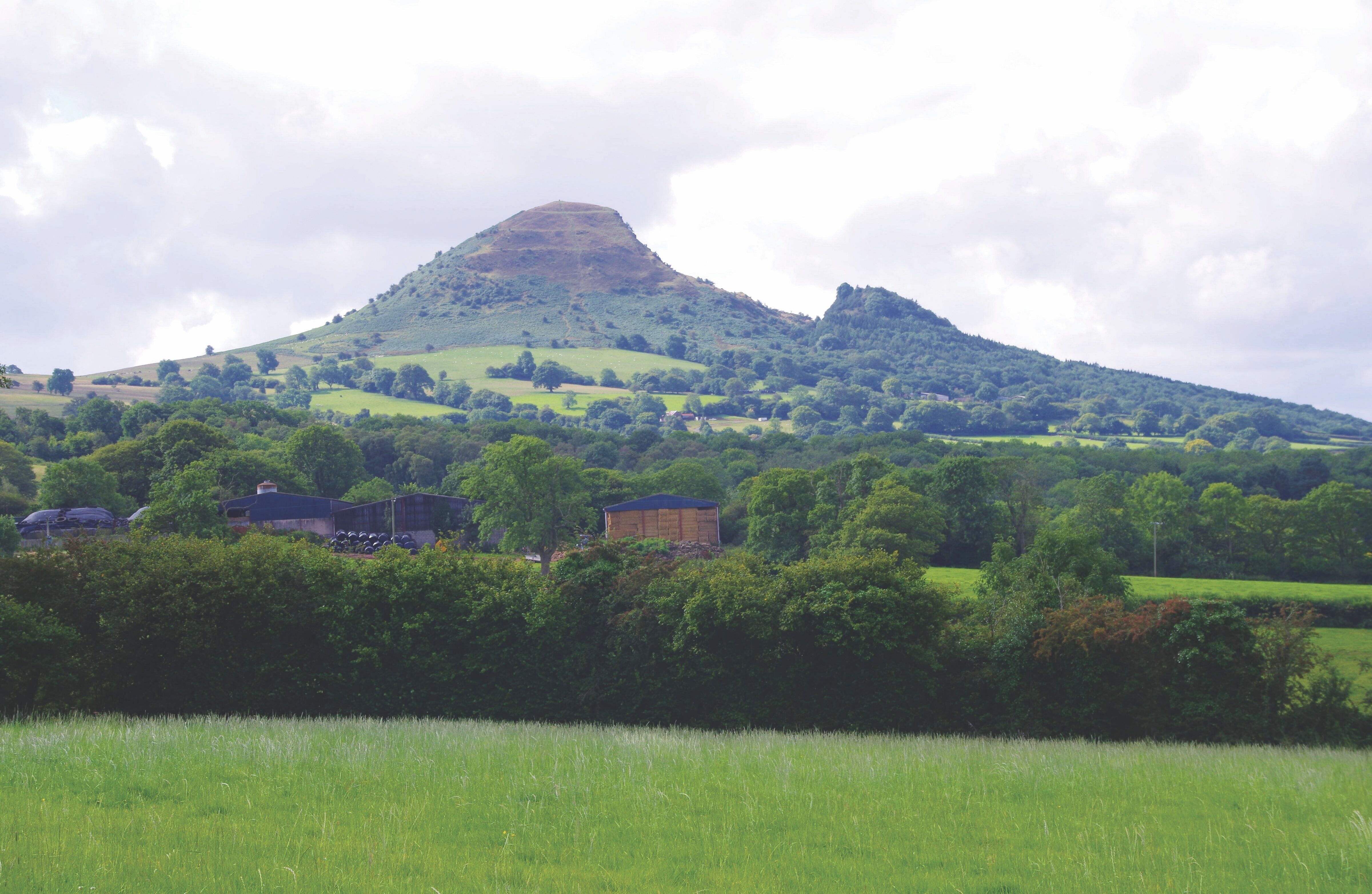
South Wales folklore is full of stories about lone travellers encountering super natural beings at night on a dark, empty highway. They are usually spectres, ghosts, goblins or beasts. But rather more unusual are sightings of something as demonic as in this story.
Back in 1909, Marie Trevelyan published two testimonies given by two travellers independently of one another. In both their accounts, these two strangers claimed that they had been the victims of attack from the Devil himself. Or at least if not Old Nick, then at the very least one of his demons.
In both their statements, the place where this attack took place was on Crack Hill. A steep hill on a rural stretch of the Via Julia Maritima; the Roman road that cuts across South Wales from east to west. It was later known as the Glamorgan Turnpike, and now is known as the A48.
Both swore on oath that their rather chilling accounts were true. Both incidents were claimed to have occurred on Crack Hill at night when travelling from Bridgend to Cowbridge. Enough to put locals off making that same journey in the dark in the future if they could help it.
In the run up to Halloween it’s a great story to share. Especially if you know the place where these events are purported to have taken place. And especially if you can shed any light on what it was these men claim to have encountered.
If you would like to read more about it, I covered this old story in my book Legends & Folklore of Bridgend and the Vale. Or watch the video version below.
Video of the demon of Crack HillCrack Hill today (well, last week)The demon of Crack Hill is a perplexing story from the late 1800s
Finish 1.30-2.00pm (depending on pace) on Barry Island
☕️🍰 Drinks & refreshments at end of walk.
27th September is the feast day of St Baruc, a monk from Llancarfan who lived at the turning point of the sixth and seventh century. This year Vale Foodbank are marking his feast day with a special event. A pilgrimage and history walk that retraces his steps from Llancarfan to Barry Island. The reason we are celebrating him, is because he is the man that Barry is named after. His “miracles” also made Barry Island a place of pilgrimage for around 1,000 years.
When the father of British history; John Leland visited South Wales in the 1530s (around 1,000 years later) he described Barry Island as a place with no buildings other than the 13th Century chapel, the remains of which you can still see on Friars Walk. He said it was a very busy place, packed with pilgrims wanting to visit the chapel and holy well of St Baruc.
You can watch a more thorough account of his story on this video.
The story of St Baruc
Regardless of whether you believe in miracles, this was the town’s founding patron, and he deserves some recognition for that.
The event is being organised by a new kind of miracle worker. The Vale Foodbank. They badly need to raise much needed funds to help provide emergency food parcels for people in crisis in the Vale of Glamorgan. Year on year they have seen demand for food parcels rocket locally. They gave out 8,662 food parcels last year from their centres in Barry, Llantwit Major, Dinas Powys and Rhoose. An increase of 29% on the year before.
Meanwhile donations have reduced by 15% as people struggle with the increased cost of living. Walkers will be charged a small fee for taking part and all profits will go direct to the foodbank. So by taking part, you can help reverse this trend.
The walk itself will start at Llancarfan, in the church on the site of the 6th Century monastery where walkers will be shown the incredible mediaeval murals on the walls. Then onto Penmark and Porthkerry and all the way to Barry Island. History experts, authors, representatives of local churches and the odd celebrity will all add snippets of history and stories to add depth to the places we will pass through.
Here’s some of the places and history you can expect along the way.
These amazing murals are in Llancarfan, where our walk begins. This was the monastery established by the amazing St Cadoc. Baruc was one of his disciples. If you want more information on him, follow this link.
In a churchyard in Monmouth stands one of the most curious tombstones in the county. And one so unique that it was given Grade II listed status in 2005. As you might expect with such a memorial, it and the man it commemorates, have quite a backstory. It concerns one man’s obsession with outsmarting the devil.
His name was John Renie and he was born in Monmouth in 1799 and worked as a painter and decorator in the town until he died in 1832. He was known to be one of the town’s more eccentric characters and nothing exemplified this more than a plan he hatched to try and ease his own passage to heaven on the event of his inevitable death. The plan was simple. He wanted his gravestone to be so confusing to read, that if the devil were to ever come looking for his soul, he would not be able to work out where his body was buried. Thus allowing Renie’s soul to slip past the devil, straight to the gates of heaven.
He became concerned that he would not be able to trust any local stone mason with this job. Either because he considered them incapable of pulling off his complex instructions, or worse, that they may reveal the secret of it to Satan himself. So to make sure the job was done properly he did the engraving himself. He dedicated years to getting it right. The end result is this fascinating and intricate, stone engraved ‘acrostic puzzle’.
It contains 285 very delicately carved letters in rows and columns. To be able to read the inscription you need to begin at a letter ‘H’ in the centre of the puzzle and follow the letters in any direction. Mathematicians who have studied the stone report that there are 32,032 different ways to read the words “Here lies John Renie”. It is quite an incredible achievement.
If the devil were not yet confused enough by John Renie’s endeavours, there is one final obstacle he might encounter if he was sufficiently determined to find his soul. And It is one Renie himself could not have foreseen but would no doubt have been absolutely delighted with. Put simply, the chances are, he probably isn’t even buried here at all!
In 1851, there was a rash of unexplained deaths amongst the residents of Whitecross Street in Monmouth. The street which runs along the edge of the churchyard at St Mary’s Priory Church, where this tombstone can be found. There were also reports of a terrible stench emanating from the raised area of the churchyard. The bodies and bones of the people buried there had become exposed by ground movement and weathering. All the exposed bodies had to be reinterred else where in the graveyard, but it was an impossible job to know who was who so they just did the best they could.
If this story is not already weird enough, the church council at the time decided to wade in with their own contribution. They felt that the churchyard looked over cluttered with memorials and headstones so a decision was taken to clear them all away as part of this work, to create a park. Only a small handful of stones now remain which have been laid out in accordance with the paths rather than where people are actually buried.
The end result. John Renie’s body could be anywhere. As could his soul.
If you want to see more of this tombstone and the yard of St Mary’s Priory Church in Monmouth, as well as other stories concerning the Devil in Monmouthshire I have made this YouTube video on the subject. Just click on the link below to watch in full. And while you are there, please subscribe to my channel.
If you would like to read more Monmouthshire related folklore, you might enjoy the blog and video available on this link. It is all about the scars of the reformation to be seen to this day at The Robin Hood in Monmouth and the White Harte in Llangybi between Usk and Caerleon. And if you like ancient Welsh myths, folklore and legends in general, then you may also be interested in the books I have written on the subject available to buy on this link. or my YouTube channel which is packed with loads of videos on the subject. Just visit https://youtube.com/GrahamLoveluck.
We sing them to our children because they have jaunty little tunes, and seem to be full of fluffy imagery and childhood innocence. But a lot of them, on closer examination, are pretty dark. They are about some of the most brutal and unsavoury episodes in our history. Disease, death, religious intolerance, war and torture. It’s no wonder babies don’t sleep through the night. So I have made a video which reveals the shocking truth about them.
You will discover, they were certainly not intended for children
In this video we answer the burning questions which must have been bothering you all these years. Questions like;
Why is rock-a-bye baby in a tree top? What was growing in Mary Mary Quite Contrary’s garden? Why did Goosey Goosey gander throw an old man down the stairs? How did Humpty Dumpty fall off the wall? Why do we all fall down in the Ring-a-ring-a-rosies? Why was Jack Horner so pleased with his plumb?
We also look at the reason these stories were given such chirpy and memorable songs and why the essence of the stories behind them were condensed down to such simple stanzas. It was in short, a very simple form of propaganda.
I hope you enjoy the video. Just click below to watch it in full and feel free to subscribe to this YouTube channel if you have not already done so.
The dark truth behind nursery rhymes and lullabies video
Let me give you a flavour of one of these supposedly innocent, children’s, nursery rhymes.
Are you familiar with Humpty Dumpty? And do you like countless millions believe this to be a song about an egg? Oh contraire! If you are not familiar with it, here is a video. The main thing to note here though is the lyrics, and they go like this:
Humpty Dumpty sat on a wall
Humpty Dumpty had a great fall
All the king’s horses and all the king’s men
Couldn’t put Humpty together again
The only reason people think this nursery rhyme is about an egg is because of a very famous illustrated, children’s story and song book from the nineteenth century. In it, the illustrator decided to depict Humpty as an egg. They did so without any integrity.
Humpty Dumpty was a killing machine. The absolute pinnacle of military engineering of its day. This was during the English Civil War which raged on from 1642 to 1651 between the “Cavaliers” who were loyal to the king and the “roundheads” who were republicans revolting to overthrow the monarchy in Britain. The Cavaliers had commissioned a huge siege cannon that supposedly combined the mobility of a small cannon with the fire power of a big one. It was not particularly portable as it was so vast and made out of iron. However, if you had enough horses and men, you could transport it to where it was needed, mount it on a stone wall (as anything less substantial than that would be destroyed by its recoil) and rain hell upon your enemy with the fire power of a fixed cannon. During a siege, when you were held inside a walled town or a castle, you never knew where your enemy might attack from so fixed cannons though powerful could be outflanked by a smart enemy. With this thing though, they had fire power wherever they needed it. As is often the case with big guns, the army had a jokey nick name for it and in this case, it was called “Humpty Dumpty”. I have to confess; I don’t know why.
During the siege of Colchester in 1648, Humpty was hauled with some difficulty, onto the top of the church tower of St Mary on the walls. Once they managed to get it up there it proved to be phenomenally successful and for 11 weeks it thundered down on the attacking “Roundheads”, blowing up everything in its range killing hundreds of men.
The roundheads knew that the only way they were going to subdue their enemy was if they took out this monstrous weapon, but on the battlefield, they had nothing that could match it for range or firepower. Eventually they managed to explode charges in the walls of the church tower itself which sufficiently weakened the structure to make it incapable of supporting this vast weapon. It broke free of the masonry that had been supporting it and tumbled over the town walls and landed barrel downward in a marsh. Because of its tremendous weight, it sunk into the ground, embedding itself to such a point that no matter how many men and horses were deployed to retrieve it, they could not pull it free.
And that is how Humpty Dumpty fell off the wall and why all the king’s horses and king’s men could not put him together again.
To be fair that one is not particularly dark. You should read the back story to ‘Rock-a-bye-baby’ though. That one really is dark!
This is a really tragic, old legend from St Athan in the Vale of Glamorgan. The back story of an oft reported aparation of a white lady ghost in a field near West Orchard Castle. With a lot of historical context.
We hear about the second crusades, the De Clare family, the Berkerolles family, the Umphraville family, and of course the local castles at the heart of the drama.
The general gist of the story is Jasper Berkerolles of West Orchard Castle marries very well, but always harbours doubts that he is punching above his weight. And when he has to go to war he becomes consumed with jealously that she is having infidelities with his neighbour. When he returns home he is so tormented he condemns her to a gruesome death.
If you, like me, love a bit of Glamorgan history, folklore and legend, you may be interested in joining me at any number of talks I am giving in the coming months. As I am a guest speaker at most of these I have given details of the organisers so where tickets are required you know how to get them. Hopefully something for everyone here.
May Walks In The Vale Of Glamorgan 2023
with Chris Jones & Guests
7th , 13th, 20th and 27th May
After the incredible success of the 10 Days in May walking festival in 2022, Chris Jones is back with another walking festival through some of the Vale of Glamorgan’s most beautiful and historic locations. The theme is very much the same as last year with guided walks, talks about points of historical interest along the way (provided by yours truly) and some surprise appearances as character actors bring to life the stories associated with the area. It is tremendous fun.
These are the walks in this years event.
Sunday 7th May – The Iolo Morganwg Heritage Walk – Starting and finishing in Cowbridge. Meet for breakfast at The Maple and Bean (opposite Waitrose) at 10am.
Saturday 13th May – Llantwit Major and the Heritage Coast – Starting and finishing in Llantwit Major – Meet for breakfast 9.30am at the Piccolo Blu Cafe.
Saturday 20th May – St Athan and Gileston Walk – Start and finish at Gileston Manor where we will meet for breakfast at 9.30am.
Saturday 27th May – Dunraven Coastal Path Walk – Meet for breakfast at 9.30am at The Three Golden Cups in Southerndown.
If you would like to register for any of these walks then please click on the link go to the Visit The Vale website for information.
If that all looks a bit too energetic, then here are some other talks you might be interested in where the audience is altogether more static:
17th May – Social Sisters Barry (The Lounge, Tadcross) 8pm
10th June (2.00pm) – “The Cult, the Captain and the Baron” – the fascinating history of St Curig’s Church, Porthkerry
📍St Curigs Church, Porthkerry CF62 3BZ
🕰 2pm Saturday 10th June
💰 Free
13th June – WI Penarth
15th June – Cowbridge U3A
1st July – Ogmore Walk and Talk
I will provide information closer to the time for The Ogmore Walk and Talk and the St Curigs Porthkerry talks.
For the other talks above I am a guest of an organisation so you will need to contact them direct for more information. Contact details are available for all on Google.
If are interested in having me come along to one of your events to speak on any of my specialist areas, please click here for more information on what I can offer.
This is Mynydd Ysgyryd Fawr (or in English; The Skirrid). It lies north of Abergavenny in Monmouthshire. It is also known as ‘The Holy Mountain’.
Technically it is a hill not a mountain but the Welsh word ‘mynydd’ doesn’t have such a strict definition criteria as its English equivalent. It just means big hill.
It has a famous legend attached to it. It was said that at the exact moment of the crucifixion the whole mountain shook until the central section collapsed giving it the distinctive outline we see today.
The name ‘ysgyryd’ is derived from the Welsh word for earth quake.
In the medieval period it was a popular place of pilgrimage and at certain points of the path you can take if you are climbing it, there are old stone steps to help the pilgrims with their ascent. It is well worth the trip as the view from the top is amazing. You can see across 4 counties.
There is also a large flat stone, possibly a Neolithic monument, known as the Devil’s Stone half way up it. This time referencing another legend that the collapsed part of the mountain was used as a seat by Satan himself.
I have quite a strong connection with the village of Laleston, near Bridgend. I grew up in the parish, went to the primary school and sang in the church choir. So speaking as someone with that background who is mad about legends and folklore and the origins of local place names, you can imagine my delight at stumbling across a legend about the origins of the name “Laleston” (or “Trelales” in Welsh). And my embarrassment at only now discovering it.
I am indebted to Bill Howells from the Llynfi Valley History Society for alerting me to it.
The story goes that the village is named after a man called Lales (pronounced “Lalless”) who was a very talented stone mason.
He was not indigenous Welsh but was captured in the holy land during the crusades. He was brought to Wales by his capturer and was put out to general duties on his master’s estate.
However the opportunity to demonstrate his true skills did not present itself quickly. After he had been in Wales for the best part of a year, it came when a stone wall enclosing a field of livestock collapsed during a storm. He was set to work to make good what he could before the animals escaped while a local stone mason was sent for.
When the local craftsman arrived at the scene the wall was not simply patched up as expected. The repairs had been completed and had been done so to a really high standard using techniques which the local man had never seen before.
The stonemason was amazed and asked Lalless how he had done the work and for him to teach the stonemason his unique abilities. Lalless unable to speak a word of Welsh and the stonemason unable to speak his language, the two men communicated solely through mime and gesture and through plans and sketches drawn in the mud with a stick.
They bonded over mutual respect and an appreciation of one another’s skills and through their love of stone.
In time they learned each other’s languages and became firm friends. Lalless converted to Christianity and became popular with local people. He and his friend the local stonemason worked on the construction of many cottages and farms in the area and most particularly the church that has ever since been the parish church of Laleston. But sadly, before the work could be completed he died.
Such was his popularity amongst the people of the village he had helped to build, that the village has ever since been known as Lalless’ town.
It is, I’m sure you would agree, a rather wonderful story. And it does go some way to explaining why the Lale part of “Laleston” is pronounced “Lall” like pal not lale like pale.
Beyond that, how likely is it to be true?
It is hard to say. Some folklore is dreamt up by bards to entertain their audience. But there is also a lot of folklore which has a truth somewhere at the heart of it. Even if evidence to back it up is thin on the ground.
We know that several local knights fought at various crusades. The 12th Century Archdeacon of Brecon and chronicler Gerald of Wales boasted in his writing at how effective he was at recruiting crusaders from amongst both Welsh and Anglo/Norman nobility in our area.
The De Chaworth brothers of Ogmore, Sir Richard Siward of Llanblethian, Sir Hugh Jonnys and Jasper Berkerolles of St Athan to name but a few. And they were lauded for their military prowess. In fact Henry II of England wrote to the Byzantine emperor to praise their military fervour, stating that “they do not hesitate to do battle”. So there is no shortage of candidates to have brought Lalless to our shores.
It wasn’t common place to capture ordinary people even skilled craftsmen and bring them back to put them to work. However kidnapping the heirs of wealthy families and holding them for ransom was very common place. So if this story is true it is more likely this was why we was brought here. And if the ransome was not paid and he was helpful to have around the place then why not keep him on.
Like so many of our fantastic legends, the mystery surrounding its origins is as tantalising as the story itself. And I love that.
Dunraven Castle used to stand on the Glamorgan coast of the Bristol Channel. Not far from Bridgend on the Heritage Coast by Southerndown beach. It has a fascinating history dating back to the Iron Age but nothing is more spectacular about this place than this legend. It is the story of the wreckers of Dunraven. The Lord of the Manor; Walter Vaughan saw his life fall apart when two of his children and his wife died prematurely. He turned to drink and gambling and squandered his fortune away. Then, when at his lowest ebb he turned for help to a henchman, a local pirate, smuggler and wrecker called Matt of the Iron-Hand who had a score to settle with his new partner in crime.
Together, they terrorised sea farers in the Bristol Channel in the sixteenth century.
They would tie lanterns to the sheep grazing on the cliff tops to mimic the lights of Newton, to lure ships onto the jagged teeth of Tuskar Rock. It kept the scavenging, coastal-living folk of the Vale of Glamorgan in a plentiful supply of plunder, washed up on their beaches from the wreckage of numerous merchant ships.
In this video I tell the best-known version of the legend. It deals with grief, greed, avarice and the final tragic outcome when all these things are allowed to come together.
I also answer the obvious question; is this a true story? What sources do we have for it? And where does Iolo Morgannwg fit into all this?
This was all filmed on location at Dunraven Castle on a cold but clear day.
The 25th January is the feast day of a 6th century Welsh saint called St Dwynwen. She is the patron saint of Welsh lovers and her own story is suitably romantic.
But who was St Dwynwen? Why is she the patron saint of lovers in Wales? What is her story? Where did that story originate? And more importantly how romantic are the Welsh?
In the video below from the History on your doorstep series we answer these and many other questions. We talk about her fascinating family tree being one of 36 children born of a family full of Kings and Queens and Saints. One of the saintly tribes of Wales. Her father King Brychan (also known as St Brychan) her sister St Gwladys, her nephew St Cadoc, founder of the Clas monastery in Llancarfan and the saint which Cadoxton in Barry is named after.
We also look at the bardic tradition in Wales and some wonderful romantic Welsh stories. Starting with the medieval romantic stories of the Mabinogion like Colhuwch and Olwen and Pwyll and Rhiannon in the first branch. We look at trends in tales of Welsh lovers and the techniques used by bards to bring them to life and look at them in the context of stories from Glamorgan. We also examine what makes them quite different from Romantic stories from ancient Greek folklore and other parts of Europe.
Specifically we look at the folklore behind the naming of the Captains Wife pub in Sully, and the better known romantic stories of the Maid of Cefn Ydfa and the Maid of Sker.
This video is a discussion between historian, author and broadcaster Graham Loveluck-Edwards and the history blogger Claire Miles (AKA Hisdoryan). First broadcast on Bro Radio on Monday 23rd January 2023. We explore the role of the bards in Wales, common themes in Welsh romantic folklore, the creative devices used by the bards to make their stories more credible and engaging.
For further reading on the themes and topics explored in this video I have written several books on local legends and folklore. More information available at https://grahamloveluckedwards.com/shop/
We use cookies on our website to give you the most relevant experience by remembering your preferences and repeat visits. By clicking “Accept All”, you consent to the use of ALL the cookies. However, you may visit "Cookie Settings" to provide a controlled consent.
This website uses cookies to improve your experience while you navigate through the website. Out of these, the cookies that are categorized as necessary are stored on your browser as they are essential for the working of basic functionalities of the website. We also use third-party cookies that help us analyze and understand how you use this website. These cookies will be stored in your browser only with your consent. You also have the option to opt-out of these cookies. But opting out of some of these cookies may affect your browsing experience.
Necessary cookies are absolutely essential for the website to function properly. These cookies ensure basic functionalities and security features of the website, anonymously.
Cookie
Duration
Description
cookielawinfo-checkbox-analytics
11 months
This cookie is set by GDPR Cookie Consent plugin. The cookie is used to store the user consent for the cookies in the category "Analytics".
cookielawinfo-checkbox-functional
11 months
The cookie is set by GDPR cookie consent to record the user consent for the cookies in the category "Functional".
cookielawinfo-checkbox-necessary
11 months
This cookie is set by GDPR Cookie Consent plugin. The cookies is used to store the user consent for the cookies in the category "Necessary".
cookielawinfo-checkbox-others
11 months
This cookie is set by GDPR Cookie Consent plugin. The cookie is used to store the user consent for the cookies in the category "Other.
cookielawinfo-checkbox-performance
11 months
This cookie is set by GDPR Cookie Consent plugin. The cookie is used to store the user consent for the cookies in the category "Performance".
viewed_cookie_policy
11 months
The cookie is set by the GDPR Cookie Consent plugin and is used to store whether or not user has consented to the use of cookies. It does not store any personal data.
Functional cookies help to perform certain functionalities like sharing the content of the website on social media platforms, collect feedbacks, and other third-party features.
Performance cookies are used to understand and analyze the key performance indexes of the website which helps in delivering a better user experience for the visitors.
Analytical cookies are used to understand how visitors interact with the website. These cookies help provide information on metrics the number of visitors, bounce rate, traffic source, etc.
Advertisement cookies are used to provide visitors with relevant ads and marketing campaigns. These cookies track visitors across websites and collect information to provide customized ads.