Posted on Leave a comment

New film about the Great Flood of 1607.

It was 9am on 30th January 1607, and the people of south Wales and the south west of England were going about their business as usual. Completely unaware of the horror that was approaching at a rate of knots.

Contemporary accounts describe what the people of places like Cardiff, Newport, Burnham-on-Sea and Ilfracombe saw that fateful morning when they looked out across the Bristol Channel. “A wall of water that did shut out even the sun”.

What was worse, this watery leviathan was fast moving. “No man could outrun it, even if riding on a galloping horse”. Over 2,000 people lost their lives that day. Thousands more died from the aftermath as famine set in. All the livestock had been drowned, top soil had been washed away and salt water contaminated the soil so no crops could grow for years afterwards. Even fresh drinking water became scarce as sea water had contaminated all the wells.

Pretty dramatic stuff I’m sure you would agree, and a story that needs to be told. So I have been planning on making a film about this event for some time.

Why this event?

I lived for many years in the pretty little village of Redwick on the Gwent Levels in Monmouthshire. A place which was wiped out at the time and has a marker on the church walls which shows how high the standing flood water was after the initial wave had gone. So, I was already aware of the event the history books call “The Great Flood”. My knowledge however was quite scant so I knew I needed to do some serious research to do it justice. Once I started pulling the various strands of research together however, I realised that this task was way too big for me to undertake on my own. So I reached out to various experts. Many in fields you would not associate with a history piece.

Archivists, meteorologists, geologists, geographers and even volcanologists all played their part in the making of this film. I learned so much more from doing this project than I ever could have imagined.

My Objectives With This Film

There were a few things I was particularly keen to do with this film.

The first was to make sure that proper emphasis was put on the price paid by the people and communities of south Wales. When I saw that Channel 5 had made a documentary called “The Killer Wave” about the event I was really interested. But was so dissapointed when I watched it to discover that it focussed entirely on the town of Barnstaple with hardly a mention of the impact on the south Wales coast. So to redress the balance my film focusses predominantly on places in Glamorgan and Monmouthshire. Barnstaple gets mentioned once.

Nothing personal – just that you’ve had your film. Now its our turn.

I also wanted to fill in some gaps in the history books. In additions to the loss of lives, livestock and property, significant buildings were lost that have never been replaced. Entire communities had to be rebuilt as 24 parishes had been lost to the waters. Also a rash of ports mysteriously disappeared around this time. I wanted to verify what was lost because of the flood and what was lost to other events (because as you will learn from this film, there were others).

Finally, I wanted to recreate some of the key events. I know not everyone is a fan of AI, but it is so much cheaper and easier to work with than CGI. So I used it to do some re-enactments and reconstructions to give a visual account of what happened.

Anyway, enough of me rambling on. The film is now done. It is 30 minutes long and it is available to watch on my YouTube channel. Please like and subscribe as the cool kids say.

To watch it from this page, simply click the image below to watch in full.

And who knows. May be we’ll feature some of these destinations in the forth coming Glamorgan History Walks programme?

#greatflood #tsunami

Posted on Leave a comment

Today’s the day for love -spells

Peasant lovers

Most people would associate the feast day of St Andrew (30th November) with Scotland. There is an old legend that this disciple from Galilee who ended up being crucified on an X-shaped cross appeared in a vision before a battle which the Scottish won. He has ever since been their patron saint . Here in Wales however, ancient folklore has a very different interpretation of where the saint’s true power and magic lies.

The Welsh have a host of superstitions and rituals associated with St Andrew’s feast day. Most are concerned with a maiden wanting to discover who her future husband would be. Here are a few, captured in the writings of Marie Trevelyan from 1908

The first was that if a maiden went to bed naked on the night of St Andrew’s feast day she would see a vision of her future intended in a dream. Another was a belief that clues to his whereabouts could be deduced from a barking dog. On the night of St Andrews day, maidens were to “take notice from which quarter of the compass” the dog was facing when barking, as that would be the direction their future love would arrive from.

It was also customary for girls to melt lead on the night of St Andrew’s feast, and pour it backwards through a key that had a cross on it, into water which had been drawn between eleven and twelve that day. As the molten metal hit the water and cooled, it would make the shape of the tools her future betrothed would use in his trade. So an axe for a woodman, a horseshoe or anvil for a blacksmith or a plough for a farmer and so on.

There is a very similar tradition associated with Halloween in Wales, so it possibly originated from the pagan festival of Nos Galan Gaeaf. This was the ancient Celtic fire festival in Wales which ushered in the Winter months. Very similar to Samhain in Ireland.

But it wasn’t all about marriage. One more general portent of the future could be derived from pouring a frothy pint of ale in a pewter tankard, on the saint’s day. If the froth ran over it was a predictor that the year ahead would have more dry days than wet ones.

I doubt if this has ever happened in Wales. As Rhod Gilbert put it “I was 9 before I realised you could take a cagoule off”.

Welsh peasants and lovers

Posted on Leave a comment

Breaking News! Book number 5 and a tour.

Scoundrels cads and vagabonds from Welsh history coming soon

Everyone knows that I am rubbish at keeping secrets, so I might as well get it off my chest now. Yes, I have a new book coming out in October. This will be my fifth book on Welsh history and folklore and this time it revels in the misdeeds of some of Wales most wicked miscreants.

It is called “Scoundrels, Cads and Vagabonds from Welsh History” and is published by Candy Jar books and distributed by Books Council For Wales/Cyngor Llyfrau Cymru.

What’s it about?

It is the definitive collection of Welsh horrible histories.

It is all based around questions such as: Who were the worst bad guys in Welsh history? The most tyrannical rulers? The most blood thirsty outlaws? The most unscrupulous traitors?

So to answer them, in this book I take a light-hearted romp through a rogues’ gallery of scandalous behaviour.

Everything from medieval miscreants to swashbuckling pirates. Even a few Kings of England thrown in for good measure.

All viewed from the perspective of the people of Wales. We look at the antics of these scoundrels and ask, “do they deserve their bad reputations?”

Just so you know, the answer is usually “yes!”

As you can guess, it is intended to be a bit of fun so as much as what is contained in it is factually correct, it is told in a manner intended to amuse and entertain. A great ‘gateway’ into history for younger readers, or an alternative narrative for people who are more absorbed by the topic.

Who is in the book?

Well I don’t want to give too much away but I do have certain rules around who is in and who is out.

First of all, to get a mention in this book you need to feature in Welsh history. That does not mean however that you have to be Welsh.

There is no question that Edward Longshanks was not Welsh. Equally however, there is no doubt that he made a big impression on Welsh history.

Secondly, there is no one in this book in living memory. My intention when writing it was to give you a light-hearted overview of some scandalous behaviour from history. The trouble with people in living memory is that commentary on their actions becomes political rather than historical and that isn’t as much fun.

So as much as you might be able to think of any number of politicians from the last 100 years who would qualify as scoundrels, none of them have made it into this book. Even though some undoubtedly deserve to be.

Finally, of course, to make it into this book you will need to have done something very naughty indeed. Something utterly scandalous in fact. It is a rogues’ gallery. A compendium of cads, scoundrels, blackguards and ne’r do wells.

How will I be able to get a copy?

It wont be available in the shops or on Amazon until 27th October but you will be able to get it earlier than that exclusively on my website from 13th October (or possibly earlier printers dependant). It will retail for £13.99.

Did you mention a tour?

Good memory. Yes I did. I have written a live show based on the book. It is predominantly a ‘history talk’ but with a few flourishes and surprises along the way to liven things up a bit. The long term plan is take it on tour to venues all over the country so more dates and venues will be announced.

In the mean time however, I have my dates and venues for January 2026 nailed down and they are part of the Glamorgan leg of the tour.

And here they are:

Thursday 8th January (7pm):   Town Hall,   Cowbridge

Friday 9th January (7.30pm):   St Mary’s Hall, Talbot St,   Cardiff

Tuesday 13th January (7pm):   The Museum,   Pontypridd

Thursday 15th January (7pm):   Pioneer Hall,   Barry

Friday 16th January (7pm):   Vivian Hall, Blackpill,   Swansea

Saturday 17th January (7pm):   Town Hall,   Neath

Thursday 22nd January (7pm):   St Augustines Hall,   Penarth

Friday 23rd January (7pm):   Town Hall,   Llantwit Major

Saturday 24th January (7pm):   Coychurch Memorial Hall,   Bridgend

Thursday 29th January (7pm):   The Prince of Wales,   South Cornelly

Friday 30th January (7pm):   Soar Centre, Penycraig,   Tonypandy

In February and March I also intend to add dates in Merthyr Tydfil, Carmarthen, Llandudno, Bangor , Wrexham, Aberystwyth, Brecon, Abergavenny, Newtown, Newport and anywhere else they’ll have me.

Tickets will cost £12 and will go on sale in October, and once again, the best place to get them is from the website.

So for the person in your life who is “difficult to buy for” here is a selection of great Christmas presents to choose from. A book and a ticket to the show for a fraction under £26. Not bad!

Scoundrels January 2026 tour poster A4

Would you like me to contact you when its available to buy?

Just in put your details below. No charge, no obligation. Once the books arrive you will be contacted and offered first dibs on a first print run of the first edition.

← Back

Thank you for your response. ✨

Posted on 2 Comments

Visiting Wales in the 18th Century – Part 1

Coalt Hoare Glamorgan Montage

When we’re on holiday I’m sure most of us like to check out online reviews and guide books. To get inspiration for places to visit.

You may be surprised how interesting it can be to do this in reverse.

I once found myself having to kill time in an airport book shop. There was the initial moment of disappointment when I discovered that they didn’t stock any of my books, but after I had got over that I started thumbing through the books they did have.

One was a guide for people visiting Wales. Out of curiosity I picked it up. I was wondering what outsiders made of places I knew and loved, and what recommendations they would make.

That got me thinking.

What did people make of Wales when they visited it back in bygone eras? What did they see? How different was their experience to that of a modern traveller?

When the grand tour was nothing to do with Jeremy Clarkson.

There was a long standing tradition amongst the young men born of aristocratic families to go on what was known as “the Grand Tour”. It meant traveling through Europe to visit the major cities and capitals of the continent to better acquaint themselves with the architecture, the art and the culture.

Then every now and then, Britain would go to war with France or Spain or the Netherlands making overseas travel too dangerous, so they would have to find destinations closer to home to explore.

Some came to explore Wales, but in these days before Trip Advisor and Expedia, they had to rely on diarists who had gone before them. To plan their routes and itineraries, and to decide where to stay.

One of my favourite pioneers of this brave new world of stay-cations, was Sir Richard Colt Hoare 2nd Baronet.

Before there was Trip Adviser, there was Sir Richard Colt Hoare

His ancestors had established Hoar’s merchant bank in the City of London in 1672. It’s still going. It’s the oldest Merchant bank in London. His father was also Lord Mayor of London, so, the family was not short of a bob or two. There are many reasons why I love Sir Richard. First of all, he was obsessed with all things historic.

He sunk a large part of his personal fortune into sponsoring archeological digs and in the acquisition of ancient texts and manuscripts. According to the Bishop of Salisbury, his library at his home at Stourhead in Wiltshire (which is now owned by the National Trust) boasted one of the finest collections of ancient manuscripts in the world. It even included writings by the legendary 13th Century Welsh Bishop, traveller and chronicler Giraldus Cambrensis (Gerald of wales).

These historic writings in particular, also inspired his other great passion. Travel.

More significantly, a desire to travel through Wales and revisit the places Gerald had written about to see how they had changed.

No doubt, also partly inspired by Giraldus, he had a hunger for documenting everything. He kept a diary and would religiously write in it about the places he visited and the things he saw. He would also meticulously record his opinions of the places he visited and the quality of the food and service at inns he stayed at.

This for me is the best thing about his diary.

That and how his experiences highlight how much travelling through Wales has changed.

Reviews of places you know

Some of Sir Richard’s experience of traveling in South Wales were “most grievious”. Not least getting here in the first place. He was of course traveling into Wales at a time before the two bridges spanning the Severn Estuary had been built. He crossed at what used to be known as ‘New Passage’. This was a ferry route between the village of Redwick in South Gloucestershire and Portskewett in Monmouthshire. This was his description of his crossing:

Thursday 2nd May 1793

“After a rough and tedious passage of two hours and a half, I landed on the opposite side of the channel. I never would recommend anyone to go over in the large passage boat (as I did) but to take a small one, as the former is generally much loaded with cattle and horses, which are not the pleasantest companions on a rough sea”

So crossing the Severn Estuary used to take up to 2 1/2 hours, and you had to share the deck with anxious livestock. I can only imagine how rough that must have been and certainly puts into context my woes of traffic jams around Bristol.

When he got to Wales though, he soon cheered up and recorded: “I proceeded to Chepstow… the Beaufort Arms is the best inn. After dinner I continued through Raglan… there is a tolerable inn… but bad attendance.”

He didn’t pull any punches with his reviews of inns he stayed or dined at.

The first time he visited Cowbridge he was clearly in a bad mood as this was how he described it

Monday 8th July 1793

“In the evening I proceeded on my journey through Cowbridge. Situated in a bottom and consisting of one long street. The inn is indifferent.” – Harsh!

For balance I should add that he came back in 1797. On his second visit he stayed at the Bear (which is still there) which he was very complimentary about.

More complimentary reviews

Another traveller of this era was a chap called The Rev William Gilpin who visited in 1770. He loved Monmouthshire in particular and described the Wye as his favourite river. He may have dismissed the countryside between Pyle and Bridgend as a “vile heath” but he went into gushing raptures about the town of Bridgend it self.

He wrote: “A beautiful landscape burst again upon the travellers. Woody banks arose on both sides… which continued a considerable way, marking the course of the river.”

Wow! That’s changed a bit then!

It is worth pointing out that the stage and post coaches of this era did not always go into Bridgend itself. If you were London bound, the most direct route was along New Inn Road in Merthyr Mawr which might explain the landscape he described.

Gilpin also loved Llanblethian and was so moved by the site of St Quentins castle, he stopped to sketch it.

Another contemporary on a similar trip was Henry Penruddocke Wyndham from Salisbury. He came in June 1777 accompanied by a Swiss artist called Samuel Grimm.

The two gentlemen’s fondest memory of visiting the area was tasing for the first time, the local delicacy of “Sewen” (also known as Sea Trout). Wyndham described it as a kind of salmon found in Welsh rivers and he extolled “its flavour is superior to any salmon” and went on “it is so plentiful… it sold for 2p a pound”.

Fish stocks and food prices another thing that is much changed.

Wyndham had intended on visiting the castles of St Donats and Dunraven but was put off by bad weather (something which deffinitely has NOT changed). Instead he only got to visit Ewenny Priory. Which he loved, despite the fact that it was in ruins at the time. He was particularly fascinated by the tomb of Maurice De Londres there.

His companion, Grimm, also drew a sketch of the priory and this was the only picture from the area which made it into his book which was published after their tour.

And to be fair to dear old Colt Hoare, as much as I love how direct his bad reviews were, he was generally, very complimentary about the area. Everywhere was described as “pretty” or “beautiful” or “picturesque”.

Except may be Llandaff Cathedral. Which to be fair was in ruins at the time, but he really did not like what they had done there…

Saturday 5th August 1777

“From Cardiff to Llandaff… village prettily situated. West front of the old cathedral bears a picturesque appearance. It is in a state of ruin. Three doors of Saxon architecture remain. Within this front another church is built, or part of the old cathedral modernised, in a style corresponding very badly to its architecture. The building is modern but the most glaring defect, and what I never recollect to have seen in any other church, is the alter, which is placed under a regular Grecian portico. In short a heathen temple is introduced within a Christian one.”

He drew the sketch below of how the cathedral looked in 1777.

Its only from reading these diaries that I become aware of how many of our churches and cathedrals were in ruins in the 18th Century. I had not appreciated the state Llandaff had got itself in until I read this passage. We take it for granted now but its easy to forget that it was not properly rebuilt until the Victorian era under John Pritchard.

I am going to start serialising the diaries of these travellers to cover the whole of Wales. Partly because I am nosey about what outsiders think of the places I know. Especially the rather grumpy and cantankerous Sir Richard Colt Hoare. The main reason I want to do it however, is because they provide such a vibrant snap shot in time of what Wales used to look like and what it was like trying to travel around it.

So stay tuned for more instalments.

Sketch of Llandaff Cathedral drawn by Sir Richard Colt Hoare in 1777

#travel #wales #history #colthoare

Posted on 2 Comments

Glamorgan Heritage: Unique T-Shirts Celebrating Local Legends

Legends T shirts montage

As you know, I am something of a nerd when it comes to Glamorgan legends and folklore. I make no apologise for that. Glamorgan can boast some absolutely incredible and fantastic stories and we have all come to love them over the years.

Here is a new way you can enjoy them and celebrate them. I have launched a new clothing brand called “Glamorgan Heritage”, and hot off the press comes this new range. A series of beautifully designed and quality made T shirts, commemorating those great stories and the people at the centre of them.

Some of them comic, some them artistic. All of them unique.

Local legends with a twist

As much as you may be familiar with the subjects and stories, you might like a couple of special new twists I have added.

First of all, each one has been designed in the style of a famous art movement. Everything from classic baroque masterpieces to pop art and comic strip. So there should be a style to appeal to everybody.

Secondly, they are also a little bit “tongue-in-cheek”. Not meant to be taken too seriously.

Here are the ones you can enjoy.

King Iestyn ap Gwrgant of Morgannwg

Iestyn ap Gwrgant was the Welsh king who lost his kingdom of Morgannwg to the invading Norman army of Robert Fitzhamon, Duke of Gloucester in 1090.

As much as he was a real person from history, there are many embellished stories and legends about him. Most from Sir Edward Stradlings “The taking of Glamorgans lands out of Welsh mens’ hands”.

On this T Shirt he has been drawn in the style of an action comic super hero. Based on his language we also catch him on a bit of an off day in his campaign against the Norman invaders.

I am sure King Iestyn would be very proud of the fact that he is available in a range of different colours, and of course, in the language of heaven. Although some poetic license is needed. Like I say, these T Shirts are just intended to be a bit of fun. I am fully aware that the words spoken by Iestyn are not what would have been used in the 11th Century.

The Coronation of King Arthur at Llandaff

Coronation of Arthur T shirt front

According to Geoffrey of Monmouth, author of “History of the Kings of Britain”, Arthur was crowned King of the Britions by St Dyfrig at Llandaff.

On this T shirt the moment has been captured in the style of a Baroque master such as Carrivagio.

Arthurian symbols such as the red dragon and the three crowns are on show. Along with the famous Epstein statue “Christ in his majesty” which was installed at Llandaff in 1954. Just in time then!

The Maid of Cefn Ydfa

One of the most enduring romantic tales ever recorded is that of Ann Maddox (nee. Thomas), the Maid of Cefn Ydfa in Llangynwyd.

In the story, when her romance with pennyless bard and thatcher Wil Hopkyn is discovered, she is imprisoned in her own bedroom with all writing materials confiscated. But so determined was she to communicate with her lover, she plucked leaves from the tree outside her bedroom window and wrote him love letters in her own blood.

Here she is captured writing the final verse of the love song “Bugeilio’r gwenith gwyn” on a leaf big enough to accomodate it. It is drawn in the style of Charles Robert Lesley’s portrait of Juliette contemplating.

Caradog tribal chief of the Silures

Caradog T shirt front

In the First Century, south Wales bravely fought off the invading Romans under the leadership of a charismatic warrior king. Caradog. Known in Latin as Caracticus.

Their defence of their lands was resolute. The most mighty empire on the face of the earth was held at bay for over a decade.

In the midst of the real history there are many legends and stories about Caradog and his brave defence of his country.

This T shirt shows Caradog in mid fight with some invading Romans. It is drawn in the style of one of my favourite comic strip characters. The cartoons of Asterix the Gaul. A fictional character with a similar CV.

The Highwayman Cap Coch

Cap Coch was a terrifying character from Glamorgan folklore.

He ran the New Inn near the Dipping Bridge in Merthyr Mawr. In the dead of night he would creep around the rooms of his guests, slitting their throats and robbing them. He would dispose of their bodies by throwing them into the river Ogmore next to the inn.

In this T shirt we have Cap Coch depicted in the Manga comic strip style. Chillingly offering someone a room facing the river.

We also have a representation of the Dipping Bridge in the background.

Cap Coch T-Shirt front

Kenfig is lost

Kenfig is lost t shirt front

The loss of a thriving community and town to nature is always the stuff of legends. And here in Glamorgan we have the incredible tale of how the once great city of Kenfig was devoured by a tidal wave and hidden forever in a watery grave beneath Kenfig Pool. All in recompense for the actions of a love sick boy who commits murder in order to make himself the suitor of the woman he loves.

The scene is captured here as the town is all but lost, in the style of the Romantic artistic movement associated with the likes of Turner and Constable.

Ifor Bach kidnaps the Earl of Gloucester from Cardiff Castle

In the 12th Century, Ifor Bach, the Welsh lord of Sengenydd was so furious with William Fitz Robert, the Earl of Gloucester for stealing his land, that one night, he and his soldiers rode up to Cardiff Castle, broke in and kidnapped the Earl.

Ifor Bach held him captive in the dungeons of Castell Coch until the Earl agreed to give back all the land he had taken plus a bit more for good measure.

Here we see the daring raid captured in the ‘Pop Art’ style made famous by the likes of Andy Warhol and David Hockney.

Ifor Bach T shirt Front

The Wreckers of Dunraven

Wreckers of Dunraven T shirt front

Walter Vaughan of Dunraven Castle, Southerndown lost his fortune at the gaming tables.

To refill the coffers he joined forces with a local pirate and cut throat called Matt o’ the Iron Hand. Together they reeked havoc on shipping trying to navigate the Bristol Channel.

Through a combination of burning a bright beacon at the castle and tying lanterns to the tails of sheep grazing on the cliff tops, they lured countless ships on to the rocks. Then they plundered what they could from the spoils that washed up on the beach.

This one done in the style of an impressionist painting.

Good aren’t they?

All of these garments are designed and distributed by the “Glamorgan Heritage” brand.

We will also be shortly announcing a range of heritage Glamorgan sporting memorabilia. Celebrating great names and teams of the past and their incredible achievements. Again, there will be a twist so watch this space.

All of these T Shirts are custom made so please read the full descriptions for an idea of turn around time. It is normally 5-7 days.

So get your orders in early for Father’s Day on 15th June 2025! Just saying!

More information on the entire range available at www.glamorganheritage.co.uk.

Glamorgan Heritage Clothing
Legends T shirts montage

Posted on Leave a comment

King Arthur’s legacy on the Glamorgan History Walks

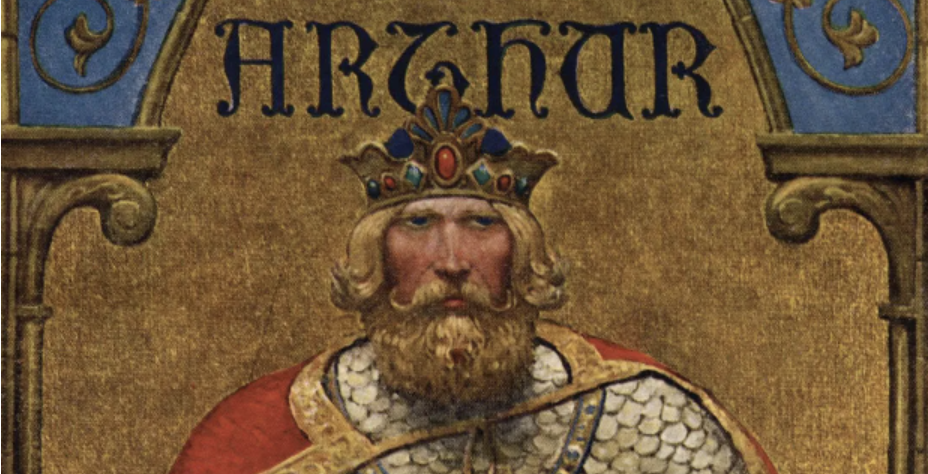
Arturos Rex (King Arthur) on his thrown

We could not possible organise a series of history walks in Glamorgan without taking in places associated with that most famous, local, kingly character; Arturos Rex. Better known as King Arthur. His enduring appeal is incredible.

The earliest written reference we have of him is a 6th Century Welsh poem called ‘Y Gododdin’. It’s not about him. He’s not even a character in it. It’s a poem about a disastrous military campaign where a gruff old warrior is described thus; “he was no Arthur”. No doubt illustrating how unsophisticated he was.

This reference, though fleeting, suggests that the name at least was already in the ether even then. And here we are, over 1,500 years later and if you do a search for him by name on any TV streaming service you are confronted with an endless parade of films, dramas and documentaries which attempt to pull together some real history from it all.

Contradictions and fake news

A lot of the stories we know about King Arthur come from a book called “The History of the Kings of Britain” written in the 12th Century. 600 years after Y Gododdin.

Despite the title of this book, there is very little in the way of genuine history in it. Before it gets on to Arthur it talks about how Britain was discovered by two Greek explorers who had to rid the island of giants before they could colonise it.

It also claims that a King of the Britons called ‘Morvidus’ was eaten by a sea monster around 336AD.

So not what you might describe as ‘reliable’.

The author, a monk called Geoffrey of Monmouth, sites a dark age predecessor called ‘Gildas the Wise’ as a source of his history about Arthur. Yet he contradicts Gildas on some really key events. Not least of which, the battle of Mons Badonicus, AKA the Battle of Baden Hill. According to Geoffrey of Monmouth this landmark battle which stoped the Saxon invasion of Britain in its tracks, was won by King Arthur. According to Gildas though (who was writing within 100 years of the battle) it was a man called Ambrosius Aurelianus. Arthur was not even mentioned as a footnote.

This is why I am instantly suspicious of anyone who claims to know deffinetavely who Arthur was. Every year, someone comes forward with yet another theory about where Camelot was or where Arthur’s tomb is. All of them interesting. But genuine history? Not so much.

Glamorgan’s Arthurian links

Having said that, we in Glamorgan are blessed with a treasure trove of places people have associated with the Legends of Arthur down the centuries. For some reason which I cannot fathom we do not seem to celebrate them in the same way as their English counterparts. If you have ever been to Glastonbury or Tintagel, you cannot move for references to their Arthurian connections. There is a gift shop on every street corner packed with roundtable mugs and Merlin figurines. There are signs up everywhere broadcasting their links and telling the stories. Even statues.

Arthurs stone Reynoldston

By contrast, you could visit Criag Y Ddinas or Llandaff Cathedral and be completely oblivious to their connections to the legendary king. We in Wales are very poor at promoting such things. And even worse at monetising them in the same way they do in England.

So we on the Glamorgan History Walks are determined to do our bit. To take you to the places in the county associated with Arthur, explain the links and tell you the stories to bring them to life. These are the ones you can visit with us and when we go there.

If you click on any of the dates in purple below, it will open a more detailed pages about the walk. It tells you how long the walk is in miles, what level of walker it is suited to, and the places we visit. You can also buy tickets.

Which Glamorgan history walks visit sites of Arthur’s stories

Come and join us on any of our walks. We’d love to see you.

A full list of walks in this year’s itinerary are available on this link. You can also read reviews of people who took part last year here.

So go ahead. Choose a walk. And I’ll see you there.

Glamorgan History Walkers
#glamwalks
Use the hashtag glamwalks to see Glamorgan History walks content on social media.

#kingarthur #arthurian #merlin #wizard

Posted on Leave a comment

Maritime history on the Glamorgan History walks

The Glamorgan Heritage Coast

It cannot have escaped your attention that Glamorgan has a spectacular coastline. And as you would expect, that comes with a wealth of maritime tradition and history.

Scott of the Antarctic

It was from these shores that Captain Scott set sail on the Terra Nova to explore the South Pole. In the 18th and 19th Century, millions of tons of coal and iron were exported from docks along this coast such as Cardiff, Barry and Swansea. And famous sea farers such as Thomas Matthews, Admiral of the Royal Navy fleet and the pirate Henry Morgan were both born here. Along with countless others.

In fact, several global sea faring traditions owe their origins to Glamorgan sea farers. Including the tale of Davy Jones’ locker which has inspired novels and Hollywood film plots by the ton. The name Davy is believed to be an anglicised corruption of Dewi. The Welsh equivalent of David.

If you are curious to discover more about this aspect of Glamorgan history, the Glamorgan History Walks are a great place to start. We have a series of walks that visit places which tell each part of the story of this county’s maritime history.

Here are the places we visit, the stories attached to them and the dates of the walks they are visited on. If you click on the date of the walk, it will open a page of information about that walk, and you will be able to buy tickets.

Ports, harbours and docks

Victorian Docks in Barry

We try and cover as many chapters of the region’s history as possible. Some of the places we visit were significant ports in the medieval period. They include Kenfig and Newton in Porthcawl. You can visit those places on these walks:

The site of Cardiff’s medieval port may come as surprise to many. But we visit that on our city centre walks – Cardiff Historic City Centre (using John Speed’s map of 1610) [8th June]…[10th July]

Aberthaw has been a port since the medieval period too. It became the busiest port in the county until Cardiff took its crown during the industrial revolution. We visit that and the remains of the old lime works. Aberthaw and Fonmon [22nd June]…[9th Aug]

Finally, Barry. Once the biggest coal exporting dock in the world. Also features on our walks. Barry Island [18th May]…[19th June]

Pirates, wreckers, smugglers and scoundrels

Smugglers and pirates

Not all of our connections with the sea are wholesome. In fact, the most interesting stories concern our colourful outlaws. Walk in their footsteps, see their hides and hear their stories. The walks where you hear the most about Pirates, wreckers and smugglers are the following:

Lighthouses, maritime architecture and landmarks

Nash Point lighthouse on the Monknash to St Donats walk on the Glamorgan History Walks and Talks
Nash Point lighthouse

We also visit some important buildings associated with our maritime history. Including:

Shipwrecks

The Bristol Channel is notorious. An incredibly dangerous waterway to navigate. On our walks we also visit the site of many shipwrecks. They include:

Come and join us on any of our walks. We’d love to see you.

A full list of walks in this year’s itinerary are available on this link. You can also read reviews of people who took part last year here.

So go ahead. Choose a walk. And I’ll see you there.

#glamwalks
Use the hashtag glamwalks to see Glamorgan History walks content on social media.

Posted on Leave a comment

Scars of World War II 80 years on

VE Day 80 years on

The 8th May 2025 marks 80 years since the end of the European leg of World War II. A series of official events are being planned all over the UK to mark the occasion. Everything from street parties to parades and marches. South Wales paid its own toll in the war. Not just through local people suffering as casualties on the front line, but also German bombing raids in 1941. Cardiff in January and Swansea in February.

VE day parade in Cardiff (May 1945)

You may be surprised at how many scars of the war are still available to see 80 years on, but if you know where to look they are all around us.

When we plan The Glamorgan History Walks festival, we try to ensure that there is a good mix of history topics to discuss. That means taking in a variety of sites which tell a story for each era.

So if the second World War is a subject you are interested in, especially in this important, commemorative year, here are the walks you can join and some of the sites you can see on them which are relevant to this important chapter in the history of the World.

There was a concern during the war, that the south Wales coast was a potential location for a German invasion. The Allies had already proven the viability of an amphibious landing at Sicily so it was not beyond the realms of possibility that the Germans might try the same here.

There were a couple of things that made south Wales viable. The sand on our beaches is very compact and forms a hard surface at low tide. Certainly hard enough to support the weight of armoured vehicles. Secondly, we are only a couple of hours drive from London. And Finally, the area, particularly when compared to the south coast of England, was poorly defended. Most of the military bases here were just training centres.

The result of this way of thinking was the re-enforcement of what few defences we had and the building of a chain of new defences. Concrete bollards nicknamed ‘dragons teeth’ sprung up along wide beach heads and routes out of the area. You can see examples on Gileston Beach which features as part of our St Athan walk on 3rd July. Bunkers and gun emplacements also sprung up along the coast.

If you come on the Glamorgan History Walks, you can visit them. They include various ‘pill boxes’ and bunkers on our walks at Llantwit Major on 12th June, St Athan on 3rd July and Monknash to St Donats on 19th July and 17th August. We also visit the site of WWI artillery gun emplacement which housed an ACAC Gun in WWII on our Barry Island walks on 18th May and 19th June. There is also a far more substantial gun battery on Lavernock Point which we visit on our Sully/Cosmeston walk on 16th August.

WWII Bunker near Llantwit Major
The bombed out shell of Llandaff Cathedral (Jan 1941)

There is also the opportunity on our walks to visit places that were changed for ever as a result of the Second World War.

In January 1941, Cardiff suffered its own blitz. The city was an obvious target as it housed one of Europe’s most significant coal exporting docks, and coal was still vital in the 1940s to Britain’s ability to wage war. It was what the Royal Navy needed to power its ships, what our trains used to move equipment, personnel and materials around the country and it was what powered our industry.

One of the casualties of these bombing raids was Llandaff Cathedral. It suffered a direct hit and had to be substantially rebuilt after the war. Here it is pictured in the aftermath.

We have walks that incorporate a visit to Llandaff Cathedral on 5th June and 21st August.

We also visit the cenotaph and garden of remembrance in Cathays Park on our Cardiff City Centre walks on 8th June and 10th July where we see more of the human cost of the war, albeit in a beautiful setting.

There were bases housing American GIs in the Porthcawl area and we also see evidence of that on a couple of our other walks. On our Kenfig and Sker walks on 24th May, also on 27th July and 14th September we see the old service road to the camp which is still there. Along with the remains of a sentry bunker. We can also see where the old air base was at nearby Stormy Down.

Meanwhile on our walks from Newton to Candleston on 7th June and also 21st September we pass through the old rifle range they trained on.

But by far the most exciting monument we have from the entire era is the wonderful Isalnd Farm POW Camp near Bridgend.

A lot of the camp has now been demolished but Hut Number 9 still stands and is a protected site. We visit it as part of our Merthyr Mawr walk on 10th May.

It is an incredible place and served several functions during the war. It started out as a dormitory for workers at the munitions factory in Bridgend. At the time, the biggest in Europe. It then became a base for US Service Personnel.

However, it is remembered in the history books for the period when it was a prisoner of war camp for high ranking German officers. Notoriety was guaranteed the night when 70 German POWs tunnelled out and escaped.

The single biggest break out of enemy soldiers in mainland Britain for the entirety of the war.

Oops!

Isalnd Farm POW Camp

What ever period of history you are interested in though, there is something for everyone on the Glamorgan History Walks. The full calendar of events is now published and tickets are on sale. Just click on this link to see them all. And if you need convincing how good these walks are, just read the feedback from people who came last year on Trip Advisor.

This video explains everything the festival of walks, history and storytelling has to offer:

#glamwalks
Use the hashtag glamwalks to see Glamorgan History walks content on social media.

Posted on Leave a comment

The Grand Welsh Historic Pub Tour.

If you have a love for history and old pubs (or if you are looking for a Christmas present for someone else who does!) then here’s a series of events you should not miss.

Historian, author and broadcaster; Graham Loveluck-Edwards (off the telly!) is hitting the road in January 2025. Touring some of the oldest and most interesting pubs in Wales. He will be delivering talks based on his best selling book “Historic Pubs of Wales“. The tour is called “Historic Pubs, and all the madness that ensued therein”.

As the name suggests, as much as these talks are based on history, the content is light and the delivery, humorous and ‘tongue-in-cheek’.

Every old pub has a mad back story and in these talks you will get to hear the best of them, told by one of Britain’s finest story tellers.

The dates and venues are as follows:

The grand Welsh historic pubs tour logo

You will hear about all the incredible folklore and history tied up in these wonderful old buildings. Whose thatched roofs, darkened beams and log fires are saturated with stories from the past.

Revealing secrets such the Cardiff pub which bears the scars of a Tsunami, the Vale pub whose landlord was the most notorious pirate on the Severn Sea, the pub on the edge of the dunes with more ghost stories than Hampton Court and many many more.

We’ll also be talking about the role of the inn and tavern in centuries gone by and what the future looks like for them too.

And answering the age old question; which is the oldest pub in Wales? All washed down with your favourite tipple of choice.

The tour, spread throughout January 2025, will take in venues across South Wales. So, you can see it in a fantastic old pub near you. Venues are all within easy reach if you happen to live in Cardiff, Barry, Cowbridge, Bridgend, Penarth, Port Talbot or Porthcawl.

Each talk will be tailored to pubs near by, so if you fancy seeing more than one talk, they will all be different.

All events start at 8pm to give you a chance to grab a pint and a bight to eat before we start. They will all be finished by 9.30pm, so no worries about getting home (or staying on for a few more drinks). Its up to you really!

Tickets are available from this website on the links below. Priced at £10 per person.

These events are e-ticketed so we will have a record of who has bought tickets. So, no need to print emails off or anything like that.

Historic Pubs and all the madness that ensued therein
Historic pubs talk by Graham Loveluck-Edwards
Posted on Leave a comment

The demon of Crack Hill

South Wales folklore is full of stories about lone travellers encountering super natural beings at night on a dark, empty highway. They are usually spectres, ghosts, goblins or beasts. But rather more unusual are sightings of something as demonic as in this story. 

Back in 1909, Marie Trevelyan published two testimonies given by two travellers independently of one another. In both their accounts, these two strangers claimed that they had been the victims of attack from the Devil himself. Or at least if not Old Nick, then at the very least one of his demons. 

In both their statements, the place where this attack took place was on Crack Hill. A steep hill on a rural stretch of the Via Julia Maritima; the Roman road that cuts across South Wales from east to west. It was later known as the Glamorgan Turnpike, and now is known as the A48. 

Both swore on oath that their rather chilling accounts were true. Both incidents were claimed to have occurred on Crack Hill at night when travelling from Bridgend to Cowbridge. Enough to put locals off making that same journey in the dark in the future if they could help it.

In the run up to Halloween it’s a great story to share. Especially if you know the place where these events are purported to have taken place. And especially if you can shed any light on what it was these men claim to have encountered.

If you would like to read more about it, I covered this old story in my book Legends & Folklore of Bridgend and the Vale. Or watch the video version below.

Video of the demon of Crack Hill
Crack Hill today (well, last week)