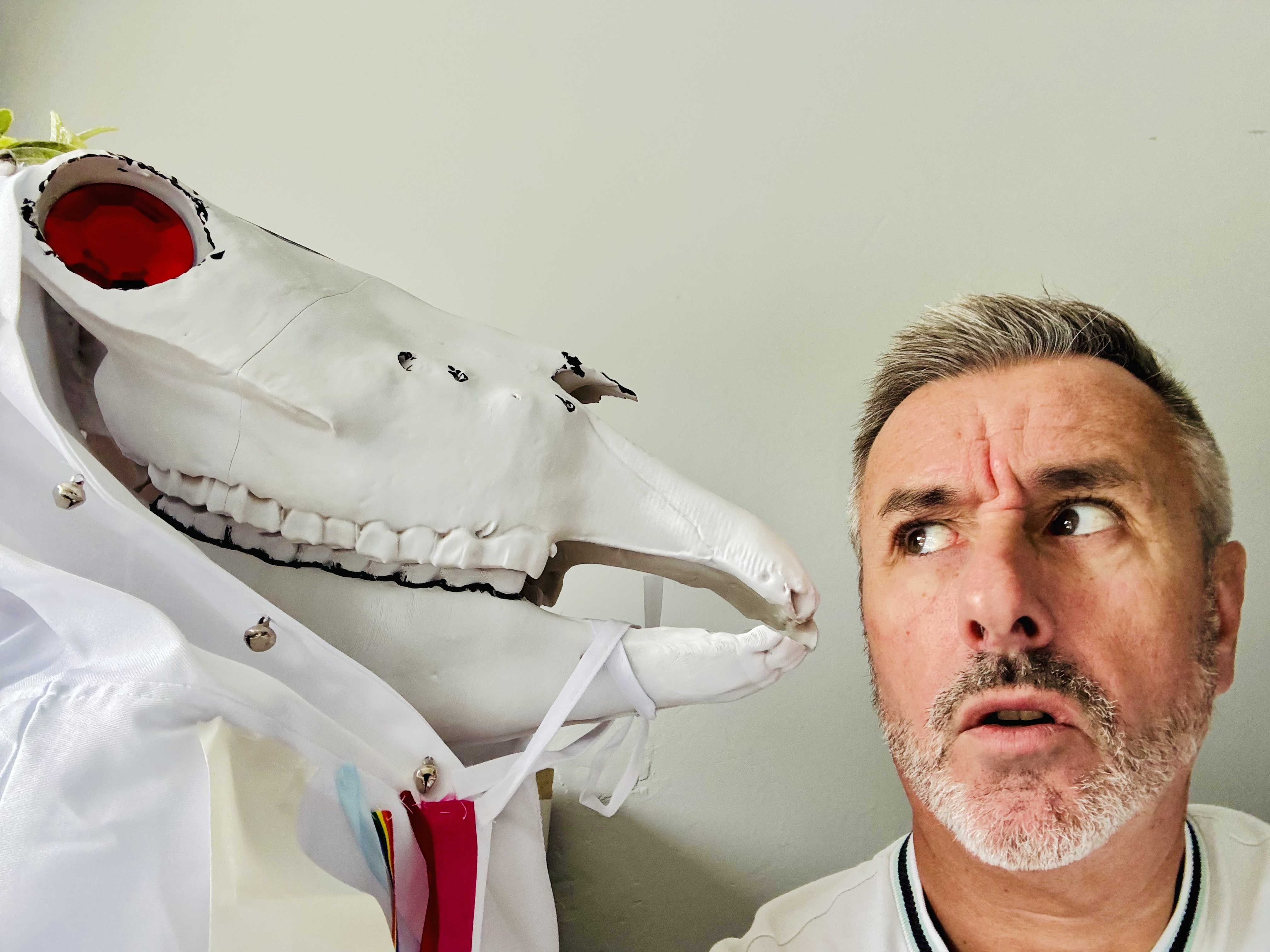
The Mari Lwyd has to be one of the most iconic symbols of Welsh folklore. In recent years it has seen something of a resurrection in popularity, and now thanks to actor Matthew Rhys talking about it on the Jimmy Falon show, it has gone stratospheric. But what is the Mari Lwyd really all about? Where and when did it originate? What does it symbolise? And most importantly, how do you make one?
My new YouTube video has just dropped and it answers these and many other question. In fact, with a bit of luck, it tells you everything you ever wanted to know about the Mari Lwyd.
You can watch it below, or if you wish to continue reading, scroll past it.
Bizarrely, it is a phenomenon which entered my life very early on. Interior Sample
In the 1970s the Old House Inn in the village of Llangynwydd was run by friends of our family, and as a young boy I would Interior Sample
visit them frequently. They lived in one of the oldest pubs in Wales, and in a dark cove at the base of a stone spiral staircase was one of the most terrifying sites I had ever seen in my life. It was a horse’s skull, darkened with age, streamers and ribbons hanging from it, mounted on a coat stand around which billowed a big white sheet. It had me running, scream- ing into the pub, much to the amusement of those gathered in it (grownups can be rubbish at times!)
In its most stripped-down form the Mari Lwyd consists of a man with a horse’s skull for a head walking from door to door on the night of Nos Galan (or New Year’s Eve). The origins of this tradition are long forgotten but there are several possible theories as to its origins.
One is that it was one of those pre-Christian festivals which the new religion rebranded and adopted to help win over local pagans.
In the Middle Ages there was a living to be made traveling from village to village performing mimes and plays about religious festivals. The protagonists in these religious shows were known as ‘mummers’, and it was troupes such as these who, at Christmas time in every town and village in South Wales, would carry the Mari Lwyd from house to house. The event was hotly anticipated. There is even a row of cottages in Cowbridge called ‘Christmas Cottages’ because they had the responsibility of keeping the Mari Lwyd through the rest of the year.
When this became a Christian tradition, there were usually three mummers to carry the Mari Lwyd, representing the Virgin, Joseph and the baby Jesus. Gradually the religious aspect dwindled, and the protagonists became just ‘the leader’, a man with a horse’s skull for a head standing under a white sheet, and his guide and accomplice who was called ‘the sergeant’. The skull was buried throughout the year in order to whiten it, and then dug up in time for Christmas. Then it was festooned with ribbons and decorations, including in some instances precious stones, before being mounted either on a stick or as a hat on the leader’s head. I have even heard of lanterns being lit inside the skull so light would shine through the eye and nasal sockets. The lower jaw was usually wired onto the main skull so it would flap as if talking or laughing as it was carried. The Mari Lwyd was usually accompanied by a large party of men and youths, often with flaming torches, following behind to watch the hilarious antics.

This was a very early form of revelry and comedy show rolled into one, and the leader and sergeant were usually chosen for their quick wit and ability to make up rhymes on demand. They would lark around like an oversized Punch and Judy show, knocking on every door and demanding hospital- ity. There was a ritual to how a householder should respond to the knock at their door. If the householder was wise, on the first knock he would keep the door barred. The assembled company would then burst into song, with a lament about the plight of the poor in winter. At the end of the song, the leader would once again knock and ask for food and drink for all assembled. The householder in response would plead poverty (ideally in song). There would then be a showdown where the leader would pit his wits against the householder with riddles. If the householder could not answer his riddle, then he had to let the party in. Food and drink would be passed around, and the Mari Lwyd would chase the women or any young children of the household. Sadly this last detail is one of the things that led to the decline of this quaint and good-humoured tradition; on occasion rough elements would infiltrate the revellers and use the Mari Lwyd as a ruse for ransacking and robbing people’s houses
The name ‘Mari Lwyd’ directly translates as ‘grey mare’, but there are conflicting accounts of what it signifies. It is believed to have some derivation from the Welsh ‘Mair’ meaning Mary, (but given how absolutely terrifying the creature looks, especially to a small boy, I think ‘grey mare’ might have the same derivation as ‘the nightmare’). The festival as it was before Christianity is likely to have been a ceremony for gathering offerings to give to the Celtic god Epona, the god and protector of horses (from whom we get the word ‘pony’). The other possibility is that it was a cere- mony designed to scare away evil and malevolent spirits during the depths of winter.
The other possibility we cannot wholly discount is that it was one of those made up traditions from the turn of the 18th Century. Things like Scottish clansmen wearing tartan kilts or the Druid ceremony of the Gorsedd of the Bards at the National Eisteddfod.
You may say that there is no datable, written reference to its existence prior to 1800. And if you did, I could not possibly comment.
Anyway, I hope you enjoy the video.
If you want to see the Mari Lwyd I made in the video in the flesh (although it doesn’t have much of that), I will be taking it on tour with me and that starts in 2 weeks time in Cowbridge. Information on the show along with venues and date available on this link.