Posted on Leave a comment

Breaking News! Book number 5 and a tour.

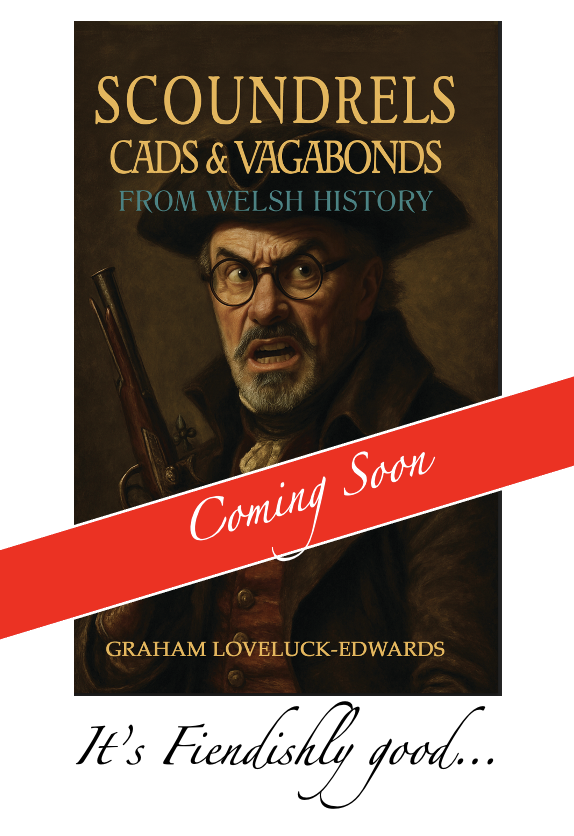
Scoundrels cads and vagabonds from Welsh history coming soon

Everyone knows that I am rubbish at keeping secrets, so I might as well get it off my chest now. Yes, I have a new book coming out in October. This will be my fifth book on Welsh history and folklore and this time it revels in the misdeeds of some of Wales most wicked miscreants.

It is called “Scoundrels, Cads and Vagabonds from Welsh History” and is published by Candy Jar books and distributed by Books Council For Wales/Cyngor Llyfrau Cymru.

What’s it about?

It is the definitive collection of Welsh horrible histories.

It is all based around questions such as: Who were the worst bad guys in Welsh history? The most tyrannical rulers? The most blood thirsty outlaws? The most unscrupulous traitors?

So to answer them, in this book I take a light-hearted romp through a rogues’ gallery of scandalous behaviour.

Everything from medieval miscreants to swashbuckling pirates. Even a few Kings of England thrown in for good measure.

All viewed from the perspective of the people of Wales. We look at the antics of these scoundrels and ask, “do they deserve their bad reputations?”

Just so you know, the answer is usually “yes!”

As you can guess, it is intended to be a bit of fun so as much as what is contained in it is factually correct, it is told in a manner intended to amuse and entertain. A great ‘gateway’ into history for younger readers, or an alternative narrative for people who are more absorbed by the topic.

Who is in the book?

Well I don’t want to give too much away but I do have certain rules around who is in and who is out.

First of all, to get a mention in this book you need to feature in Welsh history. That does not mean however that you have to be Welsh.

There is no question that Edward Longshanks was not Welsh. Equally however, there is no doubt that he made a big impression on Welsh history.

Secondly, there is no one in this book in living memory. My intention when writing it was to give you a light-hearted overview of some scandalous behaviour from history. The trouble with people in living memory is that commentary on their actions becomes political rather than historical and that isn’t as much fun.

So as much as you might be able to think of any number of politicians from the last 100 years who would qualify as scoundrels, none of them have made it into this book. Even though some undoubtedly deserve to be.

Finally, of course, to make it into this book you will need to have done something very naughty indeed. Something utterly scandalous in fact. It is a rogues’ gallery. A compendium of cads, scoundrels, blackguards and ne’r do wells.

How will I be able to get a copy?

It wont be available in the shops or on Amazon until 27th October but you will be able to get it earlier than that exclusively on my website from 13th October (or possibly earlier printers dependant). It will retail for £13.99.

Did you mention a tour?

Good memory. Yes I did. I have written a live show based on the book. It is predominantly a ‘history talk’ but with a few flourishes and surprises along the way to liven things up a bit. The long term plan is take it on tour to venues all over the country so more dates and venues will be announced.

In the mean time however, I have my dates and venues for January 2026 nailed down and they are part of the Glamorgan leg of the tour.

And here they are:

Thursday 8th January (7pm):   Town Hall,   Cowbridge

Friday 9th January (7.30pm):   St Mary’s Hall, Talbot St,   Cardiff

Tuesday 13th January (7pm):   The Museum,   Pontypridd

Thursday 15th January (7pm):   Pioneer Hall,   Barry

Friday 16th January (7pm):   Vivian Hall, Blackpill,   Swansea

Saturday 17th January (7pm):   Town Hall,   Neath

Thursday 22nd January (7pm):   St Augustines Hall,   Penarth

Friday 23rd January (7pm):   Town Hall,   Llantwit Major

Saturday 24th January (7pm):   Coychurch Memorial Hall,   Bridgend

Thursday 29th January (7pm):   The Prince of Wales,   South Cornelly

Friday 30th January (7pm):   Soar Centre, Penycraig,   Tonypandy

In February and March I also intend to add dates in Merthyr Tydfil, Carmarthen, Llandudno, Bangor , Wrexham, Aberystwyth, Brecon, Abergavenny, Newtown, Newport and anywhere else they’ll have me.

Tickets will cost £12 and will go on sale in October, and once again, the best place to get them is from the website.

So for the person in your life who is “difficult to buy for” here is a selection of great Christmas presents to choose from. A book and a ticket to the show for a fraction under £26. Not bad!

Scoundrels January 2026 tour poster A4

Would you like me to contact you when its available to buy?

Just in put your details below. No charge, no obligation. Once the books arrive you will be contacted and offered first dibs on a first print run of the first edition.

← Back

Thank you for your response. ✨

Posted on Leave a comment

The Grand Welsh Historic Pub Tour.

If you have a love for history and old pubs (or if you are looking for a Christmas present for someone else who does!) then here’s a series of events you should not miss.

Historian, author and broadcaster; Graham Loveluck-Edwards (off the telly!) is hitting the road in January 2025. Touring some of the oldest and most interesting pubs in Wales. He will be delivering talks based on his best selling book “Historic Pubs of Wales“. The tour is called “Historic Pubs, and all the madness that ensued therein”.

As the name suggests, as much as these talks are based on history, the content is light and the delivery, humorous and ‘tongue-in-cheek’.

Every old pub has a mad back story and in these talks you will get to hear the best of them, told by one of Britain’s finest story tellers.

The dates and venues are as follows:

The grand Welsh historic pubs tour logo

You will hear about all the incredible folklore and history tied up in these wonderful old buildings. Whose thatched roofs, darkened beams and log fires are saturated with stories from the past.

Revealing secrets such the Cardiff pub which bears the scars of a Tsunami, the Vale pub whose landlord was the most notorious pirate on the Severn Sea, the pub on the edge of the dunes with more ghost stories than Hampton Court and many many more.

We’ll also be talking about the role of the inn and tavern in centuries gone by and what the future looks like for them too.

And answering the age old question; which is the oldest pub in Wales? All washed down with your favourite tipple of choice.

The tour, spread throughout January 2025, will take in venues across South Wales. So, you can see it in a fantastic old pub near you. Venues are all within easy reach if you happen to live in Cardiff, Barry, Cowbridge, Bridgend, Penarth, Port Talbot or Porthcawl.

Each talk will be tailored to pubs near by, so if you fancy seeing more than one talk, they will all be different.

All events start at 8pm to give you a chance to grab a pint and a bight to eat before we start. They will all be finished by 9.30pm, so no worries about getting home (or staying on for a few more drinks). Its up to you really!

Tickets are available from this website on the links below. Priced at £10 per person.

These events are e-ticketed so we will have a record of who has bought tickets. So, no need to print emails off or anything like that.

Historic Pubs and all the madness that ensued therein
Historic pubs talk by Graham Loveluck-Edwards
Posted on Leave a comment

Unique perspective of World War II

A new book called Monica was launched on Saturday 7th October at Cowbridge Town Hall in South Wales. It tells the story of a family who fled grinding poverty and endless wars in 1920s Poland to start a new life in France. France had suffered heavy losses in World War I and needed immigrant labour to work in the mines. This family were part of that solution but shortly after moving found themselves living under German occupation in World War II.

The story is told from the perspective of the youngest member of the family.  A little girl known as Monia at home, but Monique to her French school friends. She finally becomes known as Monica when the family settled in the South Wales coal field after the war. She recounts day to day life under occupation and beyond. She also embodies some recurring themes throughout the story. The mass movement of people across war torn Europe and the breakneck pace of change in the 20th century. One of her uncles glibly comments over dinner that he was born before the Wright brothers had achieved flight but had lived to see a man land on the moon. A remark which so aptly sums that up.

At the launch, the author Graham Loveluck-Edwards talked about the very real people the book is based on. A little-known history which is part of our story of diversity in Wales.

At the end of the second World War, it was Britain which had lost so many men that additional workers were needed to fill jobs in the mines. Soldiers of the Polish Free Army had fought alongside the British. After the war they were given a choice: Return to their country of residence or stay in the UK to work in the mines here. And that was the story of this family. So, the book also deals with first impressions of South Wales in 1948, and the uniquely Welsh things which made it feel like home.

Graham also revealed at the launch that he is a lot closer to the story than people might realise. “The principal character; Monica is based on my own mother. And this is all based on the history of her family”. He went on “people who knew her from the days when she ran Sacha Boutique in Bridgend in the 1970s and the Elle Dress Agency in Cowbridge in the 1990s may remember her as a rather glamorous and flamboyant lady. They might be surprised at her humble origins in a family of Polish peasants whose existence was so precarious, they measured a good winter by the fact that everyone in the household had survived”.

Even without any personal connections, readers will find the book absorbing and the story it tells fascinating and at times, amusing. Graham who is better known for writing about ancient Welsh legends and stories about pirates and highwaymen said “you will find the stories in this book every bit as entertaining as anything I’ve ever written about pirates or mythical beasts. The difference is, there are plenty of people dotted around the UK who share this history and will see their own family history reflected in what I have written”.

Monica’ is now available to buy from this website as well as on Amazon and all good book shops.

Watch a video of the book launch event in full

Posted on 2 Comments

New book out in October | ‘Monica’

I am excited and at the same time, intrepid about the release of my latest book.

So, what’s it about you may well ask?

Well in summary, it charts the movement of a family across Europe as they try to escape from war but who inadvertently keep getting caught up in it. They start off in Poland, settle in France, then some of the men go to fight in Spain, then France,  Africa, Italy, France again and eventually Germany. Then after the war end up in Pontypridd. Meanwhile the women of the family try and maintain some semblance of normality in the wake of disappearances, food shortages and the oppression of living in an occupied country.

The central character and narrator of the story is a character called Monica Devilliers. Her story begins by charting the unique set of circumstances that led to the family ending up in France in the first place. It introduces the reader to each member of her family of larger-than-life characters and the part they played within the family and her upbringing. It also covers what it was like day to day, living under occupation for a family of ordinary working-class people. All of whom were quite resourceful.

Her father and uncle managed to get out of France, and both fought in the Polish Free Army. A perspective of World War II which is rarely told so the book also deals with what they had to face and the impact it had on the war and more significantly on them as individuals.   We also get to relive what it was like for a 10-year-old girl to come to Britain for the first time after the war and somehow make a new life for herself in the mining communities around Pontypridd and Caerphilly in South Wales, and how she used her academic capabilities to escape everything that entrapped her.

So why the intrepidation?

Well as much as this might sound like a whim of fantasy, the fact is, this is a true story and 90% of what you read in this book, no matter how spectacular, actually happened. The other reason for the sleepless nights, is that unlike my folklore and history books where I am recording the fruits of research, on this occasion I have some skin in the game. Because the life of Monica is based on the memoirs of my own mother. And the revelations in this book lay bare to the world not just a lot of interesting and amusing stories but also a lot of skeletons and scandals.

So why have I written about them?

Good question. And I need to pause for a moment before answering. There is an oft quoted maxim that runs at the heart of the answer. And that is; if every time you read about history you feel pride then you are not reading a very thorough history. In fact, it sounds like you might be reading propaganda. Yes, history contains lots of victories, successes and heroes. But they are all equally balanced by pain and disgrace and other things that are not quite so positive.Every family tries to hold up a veneer of respectability. But the truth is every family has its fair shares of alcoholics, depressives, criminals, and vagabonds. And I really mean EVERY family. So why would it come as a surprise to anyone that mine does too?

Having said that, I have changed every body’s name in this book so none of the characters share the name of who they are based on. I also may have merged a few relatives into one or attributed what happened to one person to another. Basically, because as much as I wanted to tell this story, I do not want to embarrass or humiliate any relatives or their descendants. And for that reason I moved a few villages to neighbouring villages too. Just to make sure.

If you want to know more about the book, and the stories, people, and history in it, I am holding a public event where I will discuss all and take questions from the audience. It will be held in Cowbridge Town Hall on Saturday 7th October 2023 starting at 6pm. Tickets are £5 each but that includes entry, a glass of wine and a buffet so pretty good value I’m sure you’ll agree. Tickets are available here.

The book is now available to buy here, and at Amazon and all good bookshops.

Posted on 2 Comments

The Wreckers of Dunraven

One of my all time favourite Welsh legends this.

Dunraven Castle used to stand on the Glamorgan coast of the Bristol Channel. Not far from Bridgend on the Heritage Coast by Southerndown beach. It has a fascinating history dating back to the Iron Age but nothing is more spectacular about this place than this legend. It is the story of the wreckers of Dunraven. The Lord of the Manor; Walter Vaughan saw his life fall apart when two of his children and his wife died prematurely. He turned to drink and gambling and squandered his fortune away. Then, when at his lowest ebb he turned for help to a henchman, a local pirate, smuggler and wrecker called Matt of the Iron-Hand who had a score to settle with his new partner in crime.

Together, they terrorised sea farers in the Bristol Channel in the sixteenth century.

They would tie lanterns to the sheep grazing on the cliff tops to mimic the lights of Newton, to lure ships onto the jagged teeth of Tuskar Rock. It kept the scavenging, coastal-living folk of the Vale of Glamorgan in a plentiful supply of plunder, washed up on their beaches from the wreckage of numerous merchant ships.

In this video I tell the best-known version of the legend. It deals with grief, greed, avarice and the final tragic outcome when all these things are allowed to come together.

I also answer the obvious question; is this a true story? What sources do we have for it? And where does Iolo Morgannwg fit into all this?

This was all filmed on location at Dunraven Castle on a cold but clear day.

If you want to read more about this story, I wrote about it in my book ‘Legends and Folklore of Bridgend and the Vale’. Also now available for Kindle Download.

In this video I tell the story of Walter Vaughan, the Wrecker of Dunraven and examine the likely truth of this story.
Posted on Leave a comment

From alms to ales – A potted history of the oldest pub in Swansea.

Thanks to the combined efforts of the Victorians and the Luftwaffe, most of the old inns in Swansea city centre are gone for ever, but the Cross Keys (pictured above in 1880, 1926 and now) has survived them all and has antiquity by the spade full.

The name is a nod to the legend that St Peter held the keys to the gates of heaven. A clue to its godly past. The building it self was built by Bishop Henry de Gower (Bishop of St Davids) in 1330, not as an inn but an almshouse and early hospital annexed to a monastic cell. The charter of 1332 says that it was established for ‘the support of other poor chaplains and laymen deprived of bodily health.’ It was not only there to look after people taken ill or injured, but to support the destitute, poor and starving.

The institution must have had some significant patronage, as it survived right up until the Reformation and the dissolution of monasteries in 1536. It was then confiscated by the Crown and sold to Sir George Herbert, who was a very powerful and rather unscrupulous man, descended from a family of ‘Marcher’ lords. And to make matters worse, he was from Cardiff.

He was a man of very different moral fibre to Henry de Gower, and as there was no money to be made from feeding the starving or tending to the sick, he closed down the hospital and almshouse and broke the estate up, turning the old buildings into shops and an inn. Later all the other buildings were demolished, but the inn thrived.

By the beginning of the twentieth century the pub was very dilapidated and run down. and its origins had largely been forgotten, so it was a very brave undertaking to get it all restored and renovated. But when the rendering got stripped away, to the delight of the owner who oversaw the work, a lot of the original features, like the stone arched windows and medieval timber, were re-discovered. The two bays on the St Mary Street side were added onto the original building in the seventeenth century, and it is believed that when they were built, they contained two narrow shops separated by a passageway which ran to the back of the building.

Inside there are some lovely features. The massive ceiling beams tell a story of all the walls and partitions that have been added and taken away in the last 700 years, and there are fragments of medieval roof trusses on either side of a small seating area in the lounge.

The layout of the pub today suggests that this part of the original building had two uses. The old hall would have been located on the first floor, which would have been a cleric’s living accommodation. Meanwhile below would have been part of the old hospital, possibly a ward.

This exert is taken from a new book, out now, called “Historic Pubs of Wales” by welsh author and historian; Graham Loveluck-Edwards and published by Candy Jar Books. It charts the history, folklore and incredible stories that are tied up in 89 historic pubs from all over Wales. Everything from royal patronage and assassination attempts to ghosts and priest holes. Even one which claims to have an elephant buried under the beer garden. It is available from good, independent book shops, WH Smiths, Amazon or direct from the author at a discounted price at http://grahamloveluckedwards.co.uk.

A crowd of regulars outside the Cross Keys in Swansea in 1880. Historic pubs of Wales.

Posted on 2 Comments

The Welsh festival that became Halloween

Samhain, the festival that led to Halloween started in countries like Wales.
Samhain in full swing somewhere near Llanharry

How on earth has Halloween managed to morph into some innocent, child friendly celebration day? Where kids dress up as pumpkins, collecting bowls of sweets from random strangers? It started out in the Celtic nations as the single darkest and most ominous day of the year for thousands of years.

Originally it was a pagan fire festival called Samhain. It was held at the midpoint between the autumn equinox and the winter solstice and marked the end of the plentiful months of sunlight and harvest and the beginning of the dark season. Where it gets dark however, is because the Celts believed passionately that this was the most dangerous time of year as the usual barriers that existed to keep the spirit world and mortal world separate would break down leaving the people of the world vulnerable to hauntings and possession and attacks by malevolent demons. Some even heralded it as the likely point of the end of the world – with only the year it would happen an uncertainty. This was not a mild threat. They were absolutely terrified by this possibility and it called for a mammoth, co-ordinated effort to keep themselves safe.

To empower themselves against this annual threat they would light huge bonfires with a wheel (symbol of the sun) which would maintain a bright light for as long as possible (but a minimum of 3 days). They would dress up in costumes to make themselves look as terrifying as possible and dance around the fires. This was to try and scare away their adversaries. They would also sacrifice bulls and cocks and leave the sacrifices on burial mounds as gifts for their dead ancestors. The idea was, if there was going to be a war with invading malevolent ghosts, demons and spirits, they wanted to make sure that their own ancestors would fight on their side, to ensure the evil spirits were vanquished.

They took this ceremony very seriously. Everyone had to participate in it. There was an agreement between tribes that any who were at war had to suspend hostilities during the Samhain and put their differences aside until the end of the festival to make sure nothing got in the way of everyone’s involvement. Failure to take part was punishable by death.

At the end of the 3 days ceremony, if everyone was alive and not possessed by spirits, it was clear that the alliance between the living and the dead had once again been victorious over the spirit world. So, it would be followed by a great celebration for a further 6 days. It featured a great feast where places were set for both the living and the dead combatants. Women folk would chatter into the air, to bring the dead up to date with everything that had happened through the year and a lot of merriment would take place. All to celebrate having survived the threat of invasion by the spirit world.

There were regional variants. One that always amuses me is that our ancestors here in Wales did not think that the festivities above were anywhere near mad enough. So here in South Wales it was customary for young men to hurl burning logs at each others heads in a game of ‘chicken’.

This festival was a really big deal to the pagan Welsh. Something that was massively underestimated when Christianity came along. The church wanted to stamp out all pagan practices which could not be re-branded as Christian. It was hard to see a way of making Samhain into something that was Christian friendly so they attempted to bring this practise to an end. Unsuccessfully. So, rebrand was needed. Pope Boniface in the fifth century tried the idea of a festival in May where bonfires would be lit in homage and as a celebration of saints and martyrs. But he had seriously underestimated how terrified the masses descended from the ancient Britons were of invasion by the spirit world at the end of October, so the practise continued in spite of the papal decree. Then in the ninth century (so no rush then? Only took 400 years) Pope Gregory moved “All Saints Day” (known in old English as All Hallows Day) to 1st November. The name “Halloween” comes from “All Hallows Eve”, or the day before all Saint’s Day. He also made “All Souls Day” (the day when Christians leave offerings on the graves of our dead ancestors) the day after the old Samhain; on 2nd November.

Common people found this a bit easier to swallow but it still continued to be a day marked by burning bonfires for centuries to follow. Eventually the bonfire got moved a week, supposedly to commemorate the foiling of the gun powder plot to blow up parliament. We still run with that idea today in the UK. But both bonfire night and Halloween are just continuations of Samhain in one way or another.

What amazes me though is the scale of the Halloween festival we have today. People in America spend more money on decorations and costumes at Halloween than at any other time of year besides Christmas. It has become massive. Yet I can say with hand on heart, in the UK even as recently as the 1980s it just wasn’t a thing. Bobbing for apples was about as far as it went.

by Graham Loveluck-Edwards.

About: Graham Loveluck-Edwards is a historian and author who writes regular columns in the Buddy Magazine and The Glamorgan Star newspaper. He has also published books about the history, myths, legends and folklore of Wales. They include Legends and folklore of Bridgend and the Vale and Historic pubs of Wales. Available on Amazon (in the UK and Europe) and all good UK based bookshops. They can also be bought direct from the author’s website (at a discounted price) at http://grahamloveluckedwards.co.uk with shipping available worldwide

Posted on Leave a comment

“Historic Pubs of Wales” by Graham Loveluck-Edwards reviewed by the South Wales Argus.

An AUTHOR has published a book telling the historic tales of 89 pubs across Wales – including Newport, Caerphilly, and several cross Gwent. 

Graham Loveluck-Edwards has announced the release of his new book ‘Historic Pubs of Wales’ where he relishes in some of the more colourful myths, legends and stories from Wales’ ancient past and oldest pubs. 

Included in the book is an entire chapter dedicated to Gwent, titled ‘Monmouthshire and the ancient kingdom of Gwent’ which includes pubs such as The Hanbury Arms in Caerleon, The Murenger House in Newport, The Robin Hood Inn in Monmouth and several more.

“For example, the pub which claims to have an elephant buried under its beer garden, or the pub where funeral parties take a short cut to the cemetery through the bar to keep an ancient right of access alive, or the pub that claims to have invented pancake day and so many more. 

“In all, I’ve compiled over 100 incredible stories based around 89 amazing old pubs – is there any truth to them?

“Some for sure, but this book captures them and puts them in the context of history so you can be the judge.”

The book also contains a travel guide so readers can go on a tour around Wales and visit all the pubs in the book.

You can find out more at www.talesfromhistoricpubsofwales.co.uk.  

“As you can imagine for such a book the research was relentless and thorough, and a lot of fun,” he added.

“Pubs have had such a tough time in the last year with us going in and out of lockdowns and with the introduction of social distancing measures. 

“Sixteenth century inns are usually a warren of tiny rooms so being two metres apart has made opening and trading near impossible for many. 

“So, a book which celebrates all that is great about our old pubs, which tells people their history, where to find them and what to expect when you get there has been welcomed by all landlords.”

Link to live item: https://www.southwalesargus.co.uk/news/19581611.vale-author-details-history-newport-pubs-new-book/