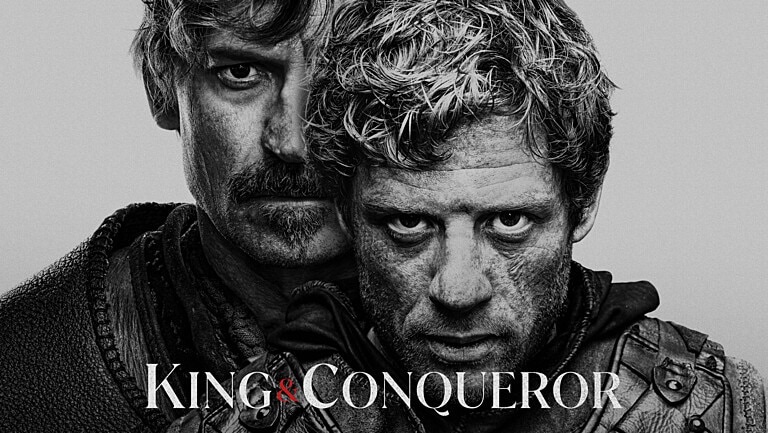
It seems that every historian worth their salt is currently slagging off the BBC Drama “King and conqueror”. If you haven’t seen it, it is loosely based on the events leading up to the Battle of Hastings in 1066.
Most of the noise is centred around “the wrong king having a moustache”.
This is a joke enjoyed by people who like to show off that they know what is on the ‘Bayeau Tapestry’.
All the characters on this famous embroidery look very similar but to help you tell them apart William is always depicted as clean shaven and Harold Godwinson with a blonde, handlebar moustache.
Yes! It’s not a very funny joke is it?
What about Edgar?

For me however, the glaring wrong I wanted to put right was to remind the world of one of the most fascinating and often forgotten characters from this whole affair who never even got a mention.
Edgar Ætheling.
He is one of the most fascinating “what-if” figures in English history—he was technically proclaimed king in 1066 but never crowned, and his whole life was shaped by being the almost-king who never quite made it.
Family Background
He was born around 1051, although we are not certain of the details. Other than to say that it is most likely that he was born in Hungary.
I told you he was fascinating.
He was the Grandson of King Edmund Ironside who was king of England for 7 whole months in 1016. His father, Edward “the Exile,” was sent abroad as a child after the Danish conquest that saw ‘Cnut the great’ crowned king. He grew up in Hungary, and only returned to England in 1057—where he died almost immediately.
This made young Edgar the last direct male descendant of the House of Wessex, the old royal line of Alfred the Great and Æthelstan.
Claim to the throne
When Edward the Confessor died in January 1066, Edgar was still a teenager. Despite being the rightful heir in strict hereditary terms, the English nobility preferred Harold Godwinson, who was militarily strong and already a power in England.
After Harold’s death at Hastings (14 October 1066), the Witan (council of nobles) briefly proclaimed Edgar king—but he was never crowned. Within weeks, Edgar and the surviving English leaders submitted to William the Conqueror, realising that resistance was futile.
Role after 1066
William took Edgar to Normandy in 1067, parading him as a sort of hostage before briefly being freed and restored to favour.
This favour was short lived though as he unwittingly became the focus of an uprising which William quashed. Edgar fled to Scotland, where his sister Margaret married King Malcolm III, strengthening his support base.
In 1069 Edgar joined a rebellion at York with Danish allies, but it failed, leading to William’s infamous Harrying of the North. Despite these efforts, Edgar never mustered enough strength to reclaim the throne.
Later life & legacy
He spent much of his life moving between England, Scotland, Normandy, and Flanders, often as a pawn in other rulers’ politics.
In 1097, he accompanied his nephew (Edgar, son of Malcolm and Margaret) back to Scotland to secure the Scottish throne. He even took part in the First Crusade (1099–1100) in the retinue of Robert Curthose, Duke of Normandy and William I’s eldest son.
After 1106 he largely disappears from records.
He died around 1126 and was buried at Gloucester, still unreconciled with his missed kingship.
Edgar Ætheling is remembered as the uncrowned king of England: Last male-line heir of the House of Wessex. Proclaimed but never crowned in 1066. A reminder of how the Norman Conquest closed the door on Anglo-Saxon royal succession.
And he didn’t even get a mention in ‘King and Conqueror’. Having said all that, as a piece of entertainment I did enjoy the series.
