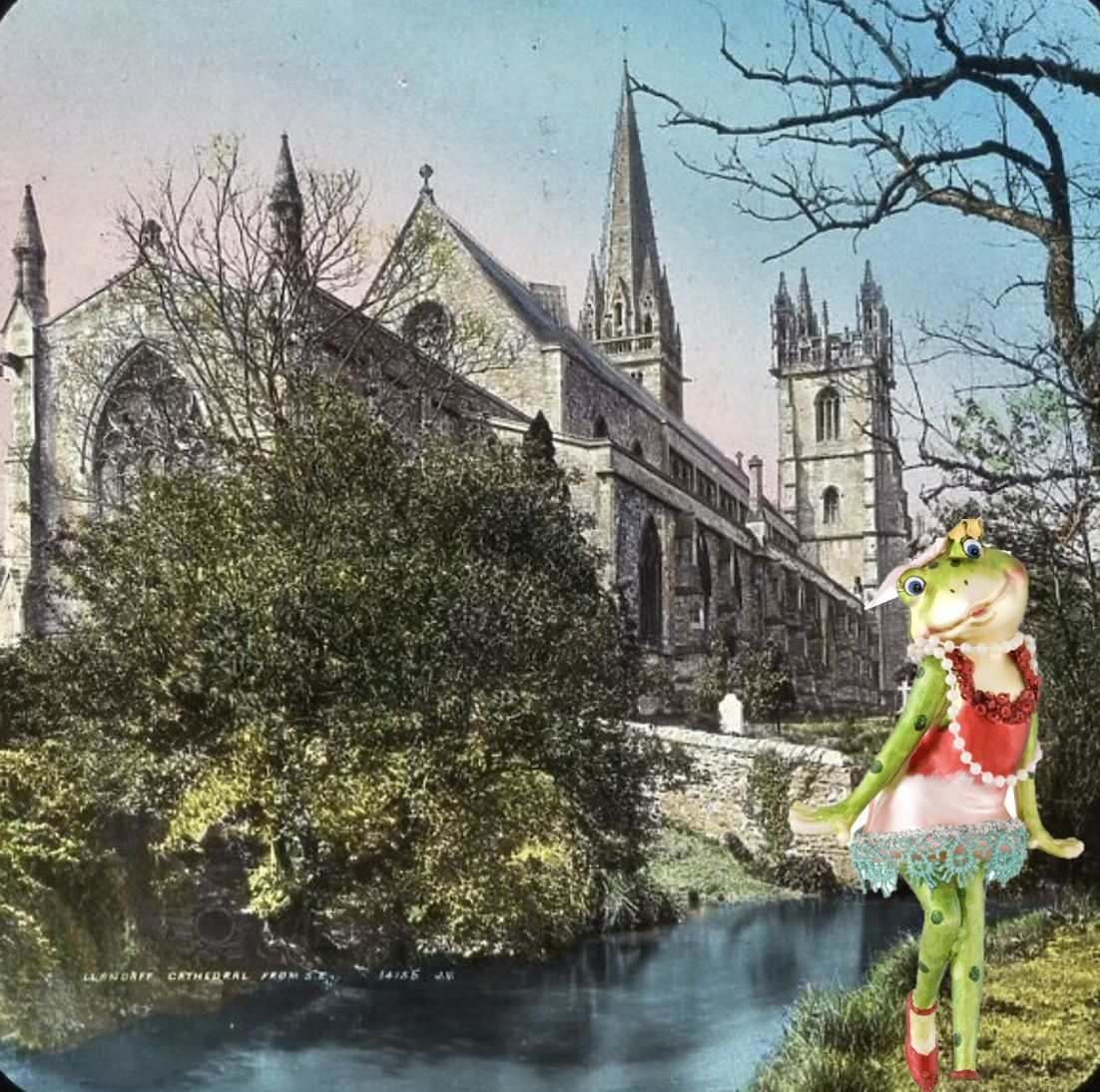
One of the more colourful creatures from Cardiff folklore is ‘the frog woman of Llandaff’. I know it sounds mad but I swear I’m not making her up. Her story was captured in 1909 by Marie Trevelyan who wrote:
“A frog-woman was known to frequent the road between Llandaff and Cardiff. Country people said she was only to be seen on moonlight nights. It was rumoured that she belonged to a ‘high family’ but had been sent ‘out of the way’ to live… This woman had the movements of a frog and her croak was unmistakable. Eventually she fell into the river Taff and for many years afterwards people believed that about midnight on moonlight nights the frog woman could be heard croaking and screaming for help”.
Sometimes you can look back on these old stories with modern eyes and make better sense of what is being described. People with hypertrichosis being described as ‘Werewolves’ for example. But I am flumaxed by what is actually being described here.
Less Welsh rarebit, more Welsh ‘Ribbit’ 🐸😂
There is a very long tradition in Welsh folklore of people who turn into creatures. Within a few miles of Llandaff, we have the tale of a werewolf living in the woods at Wenvoe and princess who was turned into a fox at Porthkerry, just the other side of Barry. Some of the earliest examples of transmogrification (as it is technically called) date back to medieval literature. In the “Book of Taliesin” the famous bard is quizzed about his abilities to change into animal form by Gwyddno Garanhir. He asked Taliesin what he was? Be he a man or a beast or a spirit? And Taliesin replied:
- “First I have been formed a comely person.
- In the Court of Ceridwen I have done penance
- Though little I was seen, placidly received
- I was great on the floor of the place I was led.
- I have been a prized defence, the sweet muse the cause
- And by law without speech I have been liberated.
- By a smiling black hag, when irritated
- Dreadful her claim when persued.
- I have fled with vigour, I have fled as a frog
- I have fled in the semblance of a crow scarcely finding rest
- I have fled vehemently, I have fled as a chain
- I have fled as a roe in an entangled thicket
- I have fled as a wolf cub
- I have fled as a wolf in the wilderness
- I have fled as a thrush of portending language
- I have fled as a fox, used to concurrent bounds of quirks
- I have fled as a marten, which did not avail
- I have fled as a squirrel, that vainly hides
- I have fled as a stag’s antler of ruddy course
- I have fled as iron in a glowing fire
- I have fled as a spearhead, of woe to such as has a wish for it
- I have fled as a fierce bull bitterly fighting
- I have fled as a bristly bear seen in a ravine
- I have fled as a white grain of pure wheat
- On the skirt of a hempen sheet entangled
- That seemed the size of a mare’s foal
- That is filling like a ship on the waters
- Into a dark leathern bag I was thrown
- And on a boundless sea I was set adrift
- Which was to me an omen of being tenderly nursed
- And the lord God then set me at liberty.”
Not known for his straight answers; Taliesin.
If you are not familiar with Llandaff, it is a very genteel suburb of the city of Cardiff in Wales 🏴. It used to be far more important than Cardiff. This is where the ancient cathedral stands so some would say it is a city within a city. In 1610 when John Speed published his map of Glamorganshire, he gave Cardiff and Llandaff separte inserts.

If you like this kind of stuff I have written a couple of books on the madder side of Glamorgan folklore. Find out more on this link.
Or if reading isn’t your thing, you can watch numerous videos on the subject on my YouTube channel on this link.


Great article and good ready , thanks, Rhidian https://cuttingedgegm.com